In the world of industrial piping, two standards dominate the market: ASTM A106 and ASTM A53. To a casual observer, these pipes might look identical. They are both black, cylindrical, and made of carbon steel. However, choosing the wrong one for a high-pressure boiler system isn’t just a financial mistake, it’s a major safety risk.
This guide provides a deep-dive comparison between ASTM A106 and ASTM A53, specifically focusing on their roles in high-pressure boiler applications and mild steel seamless piping systems.
1. Understanding the Scope: What are A106 and A53?
Before comparing them, we must understand what these standards were designed to do.
What is ASTM A106?
ASTM A106 is the “gold standard” for seamless carbon steel pipe for high-temperature service. If your application involves steam, water, or gas at temperatures reaching up to 750°F (400°C), A106 is the designated material. It is exclusively produced as a seamless pipe.
What is ASTM A53?
ASTM A53 is a general-purpose steel pipe specification. It covers seamless and welded (ERW) pipes. It is intended for mechanical and pressure applications but is typically used for lower-stress environments like air, water, and steam lines at ambient or moderate temperatures.
2. The Seamless Manufacturing Process (Exclusively A106)
ASTM A106 is produced strictly through a MS seamless Pipe process. There are two primary methods used to achieve this “solid wall” integrity:
Hot Piercing (The Mandrel Mill Process)
In this method, a solid cylindrical steel bar (called a billet) is heated to roughly 1,200°C. A piercing mandrel (a pointed metal rod) is then forced through the center of the glowing billet while rollers rotate the steel.
- The Benefit: Because the pipe is formed from a single solid piece of steel, the grain structure is uniform. There is no longitudinal seam or “joint.”
- Boiler Relevance: In high-pressure boilers, internal pressure pushes equally in all directions. A seamless pipe has no “seam” that could split or leak under extreme thermal expansion.
Extrusion
For smaller diameters or complex alloys, the steel is pushed through a die. This ensures a very smooth internal surface, which is critical for reducing friction in high-velocity steam lines.
3. The Welded Manufacturing Process (Available in A53)
ASTM A53 is often manufactured as a welded pipe (Type E or Type F). While cheaper, this process introduces a “heat-affected zone” (HAZ) along the length of the pipe.
Electric Resistance Welding (ERW – Type E)
This starts as a flat ribbon of steel (skelp) that is cold-formed into a cylindrical shape. High-frequency electrical current is then passed through the edges of the steel to fuse them together without using a filler metal.
- The Risk: Even with modern technology, the “seam” where the edges meet has a different molecular structure than the rest of the pipe.
- The “Groove Corrosion” Factor: In boiler systems using chemicals for water treatment, the weld seam in an A53 ERW pipe can sometimes corrode faster than the pipe body, leading to premature failure.
Furnace Butt-Welding (Type F)
The steel is heated in a furnace and the edges are pressed together to create a weld. This is the lowest grade of piping and is never used for high-pressure steam or boilers.
4. Why “Seamless” A53 is Still Different from A106
You might ask: “If I buy ASTM A53 Type S (Seamless), isn’t it the same as A106?” Technically, the manufacturing method is the same, but the finishing is not:
- Kill Process: A106 steel is always “fully killed.” This means during the melting stage, silicon or aluminum is added to remove all dissolved oxygen. This makes the steel much tougher and less likely to crack under the “thermal shock” of a boiler firing up.
- Hydrostatic Testing: A106 undergoes more rigorous pressure testing. While A53 is tested to ensure it doesn’t leak, A106 is tested to ensure it can maintain structural integrity at much higher stress levels over long periods.
- Surface Quality: A106 requires a cleaner finish to ensure that no microscopic surface cracks exist, which could grow into large fractures under high-pressure steam.
5. Chemical Composition: The “Silicon” Factor
In the metallurgy of carbon steel, the addition of specific elements changes how the metal behaves under extreme stress. While ASTM A106 and ASTM A53 Grade B share similar levels of Carbon and Manganese, the Silicon (Si) content is the critical divider.
Why Silicon is Mandatory for High-Pressure Boilers
ASTM A106 is a “Killed Steel.” During the melting process, Silicon is added as a deoxidizing agent to remove oxygen from the molten metal.
- Heat Resistance: Silicon increases the “creep strength” of the steel. In high-pressure boilers, pipes operate at constant high temperatures. Without enough Silicon, the steel can slowly deform over years of use (a process called “creep”).
- Structural Stability: Silicon ensures the steel maintains its grain structure when it gets red-hot. ASTM A53 does not have a minimum Silicon requirement, meaning it can become brittle or lose its shape if used in a high-pressure steam boiler for too long.
- Reduced Scaling: Silicon helps create a microscopic protective layer that prevents the inside of the pipe from “scaling” or flaking off into the boiler water, which could clog valves and pumps.
Chemical Comparison Table
| Element | ASTM A106 Grade B | ASTM A53 Grade B |
| Carbon (max) | 0.30% | 0.30% |
| Manganese | 0.29% – 1.06% | 1.20% (max) |
| Phosphorus (max) | 0.035% | 0.05% |
| Sulfur (max) | 0.035% | 0.045% |
| Silicon (min) | 0.10% | Not Required |
Key Takeaway: A106 has stricter limits on impurities like Phosphorus and Sulfur, leading to a “cleaner” and more reliable steel for critical applications.
6. Mechanical Properties: Strength Under Pressure
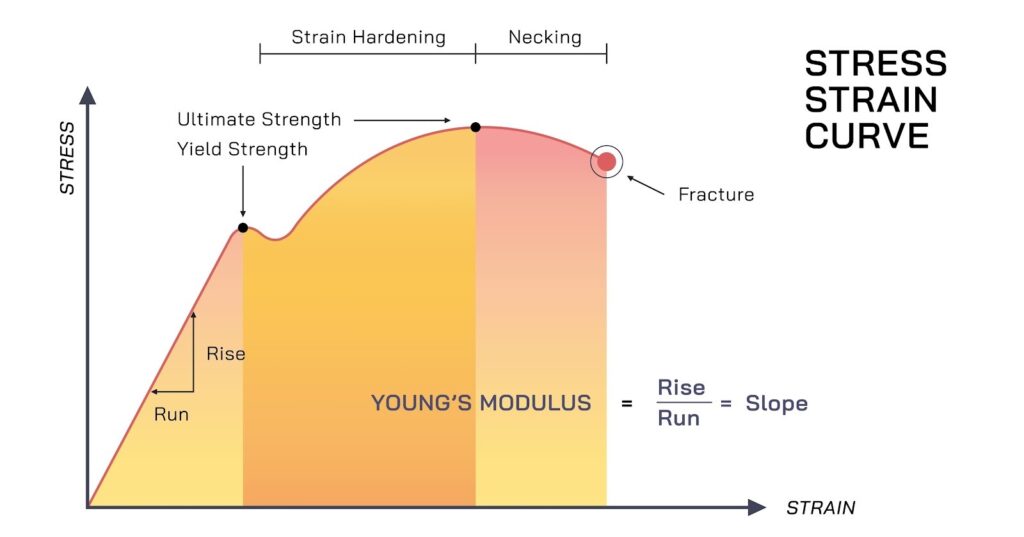
When engineers design high-pressure boilers, they look at two critical numbers: Yield Strength (the point where the pipe permanently deforms) and Tensile Strength (the point where the pipe actually breaks).
The Temperature Trap
On paper, ASTM A106 Grade B and ASTM A53 Grade B have the same minimum requirements:
- Yield Strength: 35,000 psi (240 MPa)
- Tensile Strength: 60,000 psi (415 MPa)
However, these numbers are measured at 70°F (room temperature). In a high-pressure boiler, the temperature often exceeds 600°F.
- ASTM A106 maintains its structural integrity because of its “killed steel” chemistry.
- ASTM A53 begins to lose its “allowable stress” (its safe working limit) much faster. As heat increases, the molecules in A53 steel can shift more easily, leading to thinning of the pipe walls, a phenomenon known as “creep.”
7. Why A106 is the Choice for High-Pressure Boilers
The ASME Boiler and Pressure Vessel Code (BPVC) is the “law” for high-pressure systems. In almost every high-stress section of a power plant or refinery, A106 is the mandatory selection. Here is why:
A. Total Pressure Integrity
Since A106 is 100% Mild steel seamless pipe, the pressure is distributed evenly against the walls. In a welded pipe (like A53 Type E), the weld seam is a “longitudinal stress point.” If the boiler experiences a pressure surge, a welded pipe is more likely to “split” along that seam.
B. Superior Dimensional Tolerance
High-pressure systems require precision welding between pipes and fittings (like elbows and tees).
- ASTM A106 manufacturing permits very little variation in “Out-of-Roundness” or wall thickness.
- This precision ensures that when two pipes are joined, the internal edges match perfectly, preventing turbulence and erosion inside the line.
C. Resistance to Graphitization
At long-term high temperatures, the carbon in some steels can turn into graphite, making the pipe as brittle as glass. The specific chemical makeup of A106 Grade B is designed to resist this transition, ensuring the pipe stays ductile (flexible) for decades.
8. Mild Steel Seamless Pipes: When to Use A53?
It is important to clarify that ASTM A53 is not a “bad” pipe, it is simply a different tool for a different job. For many Mild Steel (MS) Seamless applications, A53 is actually the smarter choice because it saves money without sacrificing safety.
Ideal Applications for A53:
- Structural Use: Building frames, handrails, and bollards.
- Low-Pressure Fluids: Chilled water for HVAC, drainage lines, and low-pressure compressed air.
- Galvanized Systems: If you need a pipe to resist rust in an outdoor environment, A53 is commonly available in a “Hot-Dipped Galvanized” finish. A106 is rarely galvanized because the zinc coating would fail at the high temperatures A106 is meant to handle.
- The 20% Rule: If your system operates under 300 psi and at ambient temperatures, using A53 Grade B Seamless can save you roughly 15% to 20% in material costs compared to A106.
Choosing between ASTM A106 versus ASTM A53 comes down to your operating environment. If your project involves High-Pressure Boilers or temperatures above 400°F, ASTM A106 Grade B is the only safe and compliant choice. For general Mild Steel Seamless Pipe needs at room temperature or for structural use, ASTM A53 offers the best balance of strength and budget. Need high-quality ASTM A106 or A53 pipes for your next project? Don’t leave your safety to chance. Contact our technical sales team today for a quote or a free consultation on material selection.
Frequently Asked Questions (FAQs)
1. Can I use ASTM A53 Grade B for a high-pressure boiler?
Generally, no. Most engineering codes require A106 or specific boiler-grade tubes (like ASTM A192) because of the high temperature and pressure requirements.
2. What does “Dual Certified” mean?
Many manufacturers produce a pipe that meets the requirements of both A106 Grade B and A53 Grade B. This allows the pipe to be used in either application, simplifying inventory.
3. Is ASTM A106 always seamless?
Yes. There is no such thing as “Welded A106.” If it’s welded, it’s not A106.
4. Why is A106 more expensive?
It requires higher quality raw material (lower impurities), the addition of silicon, and a more complex seamless manufacturing process.
5. At what temperature does A53 start to fail?
ASTM A53 is usually not recommended for service above 400°F (200°C), whereas A106 is rated up to 750°F.
6. Can A106 be galvanized?
It can be, but it is rare. A106 is usually intended for high-heat applications where galvanization (zinc coating) would melt or provide no benefit.
7. Is A106 better for welding?
Both have good weldability, but A106 is often easier to weld in the field because of its tighter control over chemical impurities.
8. What are the common grades of A106?
There are three: Grade A, B, and C. Grade B is the most common industrial standard.
9. Can A106 replace A53?
Yes. You can almost always “upgrade” from A53 to A106, but you cannot “downgrade” from A106 to A53 in a high-pressure system.
10. How do I identify the pipe on-site?
Look at the stencil on the side of the pipe. It will clearly state “ASTM A106 Grade B” or “ASTM A53 Grade B.” If it’s dual-certified, it will show both.