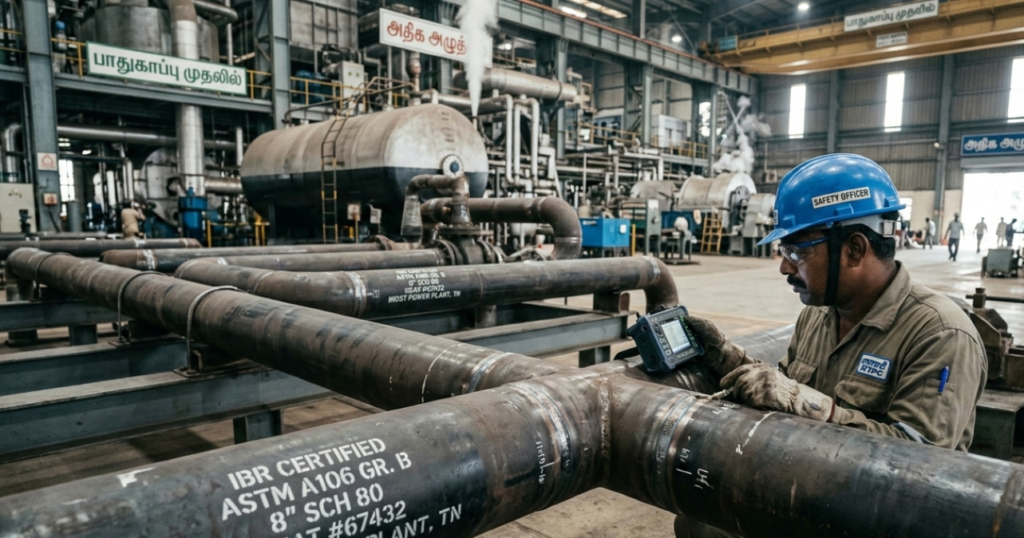
The energy sector in Tamil Nadu stands as a powerhouse of industrial growth. From the massive thermal units in Ennore and Thoothukudi to the growing captive power plants in the textile and cement belts, the demand for high-performance infrastructure is constant. At the heart of these facilities lies a complex network of piping designed to transport steam and water under extreme conditions. Among these, IBR Certified MS Seamless Pipes are the most critical components.
Understanding the safety standards surrounding these pipes is not just a technical necessity but a legal obligation under the Indian Boiler Regulations (IBR). This guide provides an in-depth look at why these pipes are the backbone of power plant safety in Tamil Nadu.
What are IBR Certified MS Seamless Pipes?
Mild Steel (MS) Seamless Pipes are manufactured through a process that involves heating a solid round billet and then piercing it to create a hollow tube. Unlike welded pipes, which have a longitudinal seam, seamless pipes have a uniform structure throughout.
When these pipes are IBR Certified, it means they have been manufactured, tested, and inspected according to the rigorous standards set by the Central Boilers Board of India. For a pipe to be “IBR,” it must be able to withstand the specific design pressure and temperature of the boiler system it integrates with.
The Importance of “Seamless” in High-Pressure Systems
In a power plant, steam is often transported at pressures exceeding 100 kg/cm² and temperatures above 400°C. A welded pipe has a “weak point” at the seam where the metal was joined. Under extreme thermal expansion and high pressure, these seams are prone to failure. Seamless pipes eliminate this risk by providing:
- Uniform Strength: The absence of a weld ensures the pipe can handle pressure equally at all points.
- Dimensional Accuracy: Seamless pipes offer better wall thickness consistency, which is vital for calculating safety margins.
- Corrosion Resistance: In the coastal regions of Tamil Nadu, such as Chennai and Cuddalore, the internal and external integrity of the pipe is paramount to prevent premature failure.
The Legal Landscape: Tamil Nadu Boiler Directorate
The Tamil Nadu Boiler Directorate is the state-level authority responsible for enforcing the Boilers Act, 1923 and IBR 1950. Every piece of piping used in a steam-generating system in the state must be registered with and inspected by this department.
Operating a power plant with non-IBR pipes is a criminal offense. More importantly, it invites the risk of catastrophic boiler explosions. The Directorate ensures that every pipe used has a valid Form III-A (for pipes) or Form III-C (for fittings), which acts as a birth certificate for the material, detailing its chemistry, strength, and the name of the approved inspecting authority.
Why IBR Certification is the Gold Standard for Safety
1. Material Traceability
Every IBR pipe is stamped with a unique heat number. This allows engineers to trace the pipe back to the specific batch of steel used. If a defect is found, the entire batch can be identified and replaced before a failure occurs.
2. Rigorous Testing Requirements
To receive IBR certification, MS Seamless pipes must undergo:
- Chemical Analysis: Ensuring the carbon and manganese levels are within safe limits.
- Tensile Testing: Measuring the maximum stress the pipe can handle.
- Flattening and Flaring Tests: Checking for ductility and cracks.
- Hydrostatic Testing: The pipe is filled with water at 1.5 times its rated pressure to ensure there are no leaks.
3. Preventing “Creep” and Fatigue
In power plants, pipes are subjected to constant heating and cooling. Over time, this leads to “creep” , a slow deformation of the metal. IBR standards dictate the use of specific grades, like ASTM A106 Grade B, which are specifically engineered to resist creep at high temperatures.
Common Material Grades Used in Tamil Nadu Power Plants
While “MS” is a broad term, specific grades are mandated based on the application:
- ASTM A106 / SA106 Grade B: The most common grade for high-temperature service. It offers a perfect balance of weldability and strength.
- ASTM A53: Often used for lower pressure applications or general-purpose steam lines.
- API 5L: Primarily used for long-distance transport, though sometimes adapted for specific utility lines within a plant.
The Challenges of the Tamil Nadu Climate
Power plants in Tamil Nadu face unique environmental challenges. The high humidity and salinity in coastal areas like Nagapattinam can cause rapid external corrosion.
IBR MS Seamless Pipes are often treated with anti-corrosive coatings like black bitumen or galvanization. However, the IBR regulations focus on the internal pressure-bearing capacity. Plant managers in TN must supplement IBR standards with robust external maintenance schedules to ensure the pipes do not thin out due to environmental factors.
Documentation: Form III-A and III-C
When you purchase IBR Certified pipes, they must be accompanied by original documents.
- Form III-A: This is the manufacturer’s certificate for the pipe itself. It must be countersigned by an IBR-authorized inspector.
- Form III-C: This applies to the fabricated pipework. It confirms that the welding and layout were done by IBR-qualified welders and inspected at the site.
Without these forms, the Tamil Nadu Boiler Inspector will not grant the “Fitness Certificate” required to start the boiler.
Ensuring Quality: How to Verify Your IBR Pipes
- Check the Stamping: Every IBR pipe has a hard stamp near the end including the manufacturer’s logo, the heat number, and the IBR inspector’s seal.
- Verify the Inspector: Ensure the certifying authority is recognized by the Central Boilers Board.
- Physical Inspection: Look for the absence of any longitudinal marks which might indicate a welded pipe passed off as seamless.
The Financial Impact of Compliance
While IBR certified pipes carry a premium price (often 15% to 25% higher than non-IBR pipes), the ROI is found in safety and insurance. Most industrial insurance providers in India will not cover a power plant unless all steam-bearing components are IBR compliant. One day of unplanned shutdown due to a pipe burst can cost a TN power plant millions in lost revenue, far exceeding the initial cost of certified materials.
Are you planning a boiler overhauling or a new piping installation for your power plant in Tamil Nadu? Ensure your facility remains safe and legally compliant by sourcing only genuine IBR Certified MS Seamless Pipes.
Contact our Black Buildtech team today for a Detailed Consultation on IBR compliance and material selection for your specific industrial requirements.
FAQs
1. What is the difference between IBR and non-IBR pipes?
IBR pipes are manufactured and tested under the strict supervision of the Indian Boiler Regulations authorities. They are mandatory for any steam line where the pressure exceeds 3.5 kg/cm² or the internal diameter exceeds 10 inches. Non-IBR pipes do not undergo this government-mandated inspection and are used for water or air lines.
2. Is IBR certification mandatory for power plants in Tamil Nadu?
Yes. Under the Boilers Act 1923, any steam pipe used in a power plant or industrial boiler system in Tamil Nadu must be IBR certified and registered with the State Boiler Directorate.
3. What material grade is best for IBR MS Seamless Pipes?
ASTM A106 Grade B is the most widely used grade for high-pressure and high-temperature steam applications in Indian power plants due to its excellent durability and pressure-bearing capacity.
4. How can I identify a genuine IBR pipe?
A genuine IBR pipe will have a hard-stamped mark containing the manufacturer’s name, the heat number, the inspector’s stamp, and the test pressure. It must also be accompanied by a Form III-A certificate.
5. Can I use welded pipes instead of seamless pipes for IBR applications?
While IBR allows certain ERW (Electric Resistance Welded) pipes for specific low-pressure applications, “Seamless” pipes are generally required for high-pressure steam lines because they lack a welded joint, making them significantly safer.
6. Who is the governing authority for IBR in Tamil Nadu?
The Directorate of Boilers, Tamil Nadu, located in Chennai, is the primary authority for the registration, inspection, and certification of boilers and piping within the state.
7. Does IBR certification expire?
The material certification (Form III-A) does not expire, but the “Certificate for Use” of the piping system must be renewed annually after a physical inspection by a Boiler Inspector.
8. Are IBR pipes more expensive?
Yes, they are generally more expensive because of the cost of high-quality raw materials, the additional testing required (like Hydro-testing and NDT), and the fees for government-authorized inspections.
9. What is Form III-A in IBR?
Form III-A is the official certificate of manufacture and test for pipes. It proves that the pipes have been manufactured and tested according to IBR 1950 standards.
10. Can IBR pipes be used for non-steam applications?
Yes, you can use IBR pipes for water, oil, or gas, but it is often not cost-effective. However, using them ensures a much higher safety margin than standard commercial pipes.