Selecting the correct wall thickness for your piping system is one of the most significant decisions in any engineering project. In a fast-growing industrial hub like Coimbatore, where sectors range from high-pressure pump manufacturing to complex textile processing, the integrity of your fluid transport system depends on the “Schedule” of your pipe.
When we talk about Seamless Pipes, the term “Schedule” (often abbreviated as SCH) refers to the wall thickness. It is a common misconception that the schedule stays the same across all sizes. In reality, as the pipe diameter increases, the actual thickness for a specific schedule also changes
Understanding the Basics of Pipe Schedules
To select the right thickness, you first need to understand that MS Pipes are categorized by their Nominal Pipe Size (NPS) and their Schedule. The schedule number is roughly related to the pressure-holding capacity of the pipe.
SCH 40 is considered the “Standard” weight. It is the most widely used thickness for low to medium-pressure applications. SCH 80 is known as “Extra Heavy.” It has a thicker wall, which allows it to handle significantly higher pressures and provides a greater margin of safety against internal and external wear.
SCH 40 vs. SCH 80: The Technical Differences
The primary difference between these two is the internal diameter. For a 2-inch Mild Steel Seamless Pipe, the outer diameter (OD) remains the same regardless of the schedule. However, because the wall of an SCH 80 pipe is thicker, its internal diameter (ID) is smaller than that of an SCH 40 pipe.
- SCH 40 MS Pipe: Best for general plumbing, air lines, and low-pressure water transport. It is lighter, easier to weld, and more cost-effective for broad applications.
- SCH 80 MS Pipe: Required for high-pressure steam, chemical transport, and structural applications where the pipe might be subjected to heavy external loads.
Key Factors in Selecting Wall Thickness
1. Internal Operating Pressure
Pressure is the most critical factor. Every Mild Steel Seamless Pipes has a maximum allowable working pressure. If your pump system in Coimbatore operates at 400 PSI, using an SCH 40 pipe might be “pushing the limit” depending on the temperature, whereas SCH 80 would provide a comfortable safety buffer. Always check the pressure rating tables provided by manufacturers or international standards like ASME B36.10.
2. Corrosion and Erosion Allowance
Coimbatore’s industrial environment often involves water with high mineral content or chemical additives in textile dyeing. Over time, the internal surface of a Mild Steel Pipe will corrode.If you choose a thinner wall (SCH 40), a corrosion loss of 1mm could represent 20% of the pipe’s strength. If you choose a thicker wall (SCH 80), that same 1mm loss might only represent 10% of the strength. Therefore, for lines that are difficult to replace or carry corrosive fluids, SCH 80 is the “Gold Standard” for longevity.
3. Temperature Variations
As the temperature of the fluid (like steam in a textile mill) increases, the strength of the mild steel decreases. A pipe that can handle 500 PSI at room temperature may only safely handle 300 PSI at 200°C. For high-temperature applications, engineers in Coimbatore usually upgrade to a higher schedule to compensate for this loss of metal strength.
Coimbatore Industry Applications
The Pump and Agriculture Sector
Coimbatore is world-renowned for pump manufacturing. For suction and delivery lines in agricultural setups, MS seamless Pipes of SCH 40 are usually sufficient. They offer a balance of durability and weight, making them easy to install in deep-well scenarios without putting excessive strain on the lifting equipment.
Textile and Dyeing Units
Textile units require massive amounts of steam. These steam lines operate under high pressure and constant thermal cycling. Using Seamless Pipes with an SCH 80 rating is common for main steam headers. The extra thickness prevents “sagging” of long pipe runs and provides better resistance to the high-velocity steam that can erode thinner pipe walls.
Structural and Engineering Projects
In heavy fabrication and foundry work, pipes are often used as structural columns or supports. Here, the “Schedule” represents the load-bearing capacity. SCH 80 pipes provide superior rigidity and are less likely to buckle under heavy mechanical stress compared to their thinner counterparts.
How to Calculate: A Simplified Approach
While professional engineers use complex software, a simple way to estimate is using Barlow’s Formula:
$$P = \frac{2St}{D}$$
- P = Internal Pressure
- S = Allowable Stress of the Material
- t = Wall Thickness
- D = Outside Diameter
By rearranging this, you can find the minimum thickness (t) required for your specific pressure (P). If the calculated thickness is 4.5mm and SCH 40 is only 3.9mm, you must move up to SCH 80 (typically 5.5mm for that size) to remain safe.
Sourcing in Coimbatore: What to Look For
1. The “Visual and Surface” Audit
Seamless pipes are manufactured by piercing a solid billet, whereas ERW (Electric Resistance Welded) pipes are made from flat strips welded together.
- Internal Bead: Run your finger (carefully) or use a flashlight to inspect the internal diameter. A true MS seamless pipe will have no longitudinal weld seam. If you see or feel a slight ridge running the length of the pipe, it’s ERW.
- Surface Finish: Genuine seamless pipes usually have a smoother, more uniform surface. Look for excessive scaling or pitting, which can indicate poor storage or recycled scrap material.
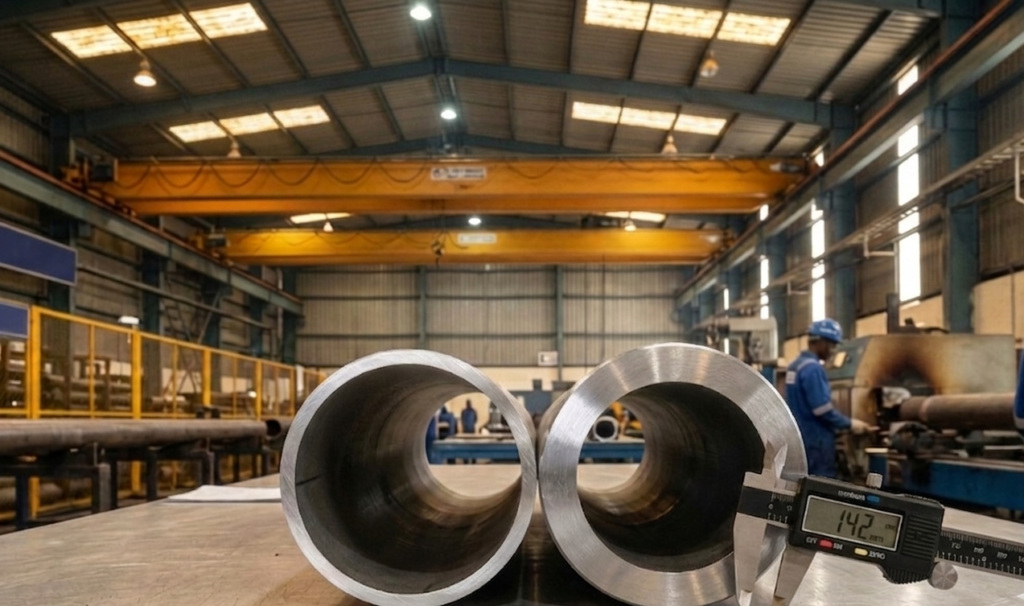
2. Deep Dive into Wall Thickness (The Micrometer Test)
As you mentioned, consistency is king. However, you should check more than just the ends.
- The “Ovality” Check: Use the micrometer to measure the thickness at four different points around the circumference of the pipe end (12, 3, 6, and 9 o’clock).
- Tolerance Standards: Refer to the ASTM A106 or API 5L standards. Generally, the minimum wall thickness at any point should not be more than 12.5% under the nominal wall thickness specified.
3. Understanding the Weight to Schedule Relationship
You mentioned SCH 80 vs. SCH 40. It’s helpful to have the theoretical weight formula handy to see if the dealer is “shorting” you on material.
The theoretical weight ($W$) of a steel pipe in kg/m can be calculated as:
$$W = 0.02466 \times (D – t) \times t$$
Where:
- $D$ = Outside Diameter (mm)
- $t$ = Wall Thickness (mm)
If the physical weight is significantly lower than this calculation, the pipe is likely “under-tolerance” or a lower schedule than advertised.
4. The “Coimbatore Market” Specifics
- Standard Lengths: Seamless pipes typically come in “random lengths” (5 to 7 meters). If a dealer offers perfectly uniform 6-meter lengths for every single pipe without a premium charge, they might be processed ERW pipes cut to size.
- Brand Reputation: In the local market, look for reputable brands like MSL (Maharashtra Seamless) or Jindal. If the pipe is unbranded or “imported” without clear documentation, proceed with extreme caution.
Are you unsure which pipe schedule is right for your next project? Selecting the wrong wall thickness can lead to system failure or unnecessary costs. At Black Build Tech, we provide expert guidance and a wide range of IBR and Non-IBR Mild Steel Seamless Pipes to meet your specific industrial needs.
Contact our team today for a free consultation and a competitive quote on SCH 40 and SCH 80 seamless pipes.
10 Frequently Asked Questions (FAQs)
1. Does SCH 40 have the same wall thickness for all pipe sizes?
No. As the Nominal Pipe Size (NPS) increases, the wall thickness for SCH 40 also increases. For example, a 1-inch SCH 40 pipe is thinner than a 4-inch SCH 40 pipe.
2. Can I use SCH 40 for high-pressure steam?
Generally, no. For high-pressure steam (above 150 PSI), SCH 80 is usually the minimum requirement due to safety standards and the risk of thermal fatigue.
3. Is MS Seamless Pipe stronger than MS Welded Pipe?
Yes. Because MS Seamless Pipes have no welded seam, they are considered 20% stronger than welded pipes of the same material and thickness, making them better for high-pressure use.
4. How do I identify if a pipe is SCH 40 or SCH 80 on-site?
Most pipes have the schedule printed on the surface. If the print is missing, you can measure the wall thickness with a caliper and compare it to a standard pipe schedule chart.
5. Why is SCH 80 more expensive?
SCH 80 pipes have thicker walls, which means they contain more steel per meter. The price is higher because you are essentially buying more raw material.
6. Which schedule is better for underground water lines in Coimbatore?
For underground lines, SCH 40 is usually sufficient if the pressure is low. However, if the pipe is buried under a driveway where heavy trucks pass, SCH 80 is better to resist external crushing.
7. Does the internal diameter change between SCH 40 and SCH 80?
Yes. Since the outer diameter (OD) is fixed, the thicker wall of the SCH 80 pipe makes the internal hole smaller, which slightly reduces the flow capacity.
8. What is the most common material grade for MS Seamless Pipes?
ASTM A106 Grade B is the most common grade for Mild Steel Seamless Pipes used in high-temperature and high-pressure industrial applications.
9. Can I mix SCH 40 and SCH 80 in the same line?
It is not recommended. If you must mix them, ensure that the pressure rating of the entire system is limited to the capacity of the weakest (thinnest) pipe used.
10. Where can I buy genuine MS Seamless Pipes in Coimbatore?
Coimbatore has many industrial dealers, but it is best to buy from established suppliers like Black Build Tech who provide Mill Test Certificates and IBR documentation.