
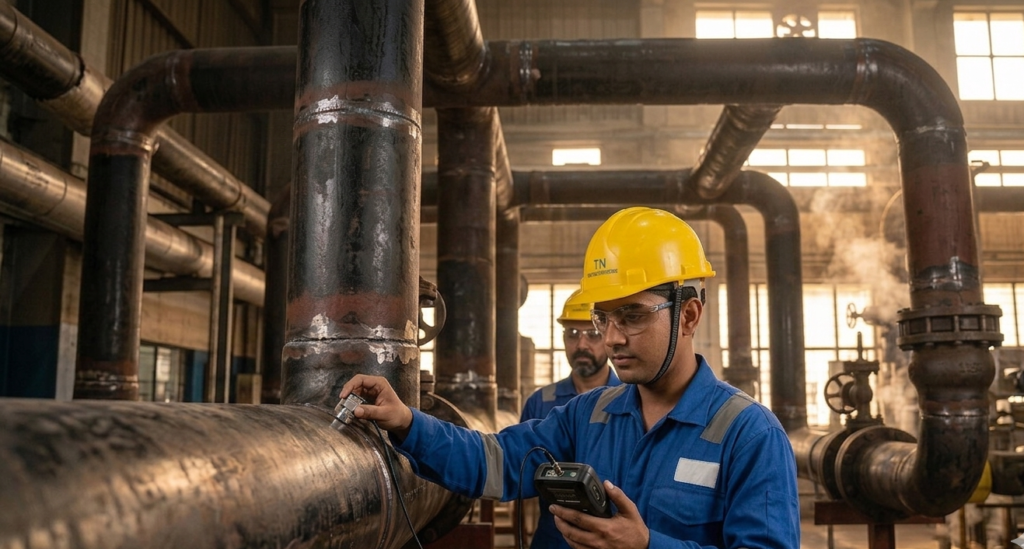
In the industrial corridors of Tamil Nadu stretching from the thermal power hubs of Thoothukudi to the massive refineries in Manali steam is the lifeblood of production. However, steam at high temperatures is not just a utility; it is a high-energy force that puts immense stress on its containers. In this demanding environment, Seamless Pipes have emerged as the undisputed gold standard.
While there are many piping options available, the unique manufacturing process and metallurgical properties of seamless mild steel make it the only logical choice for high-pressure steam conveyance. This guide explains why “Seamless” is synonymous with “Safety” in the TN industrial landscape.
In simple terms, a seamless pipe is superior because of how it is made. Most pipes are made by rolling a flat sheet of steel into a circle and welding the edges together. However, a mild steel seamless pipe is made by piercing a solid red-hot cylinder of steel. This means there is no joint or “seam” anywhere on the pipe.
In the busy factories of Tamil Nadu, from the textile mills in Tirupur to the sugar factories in Trichy, steam is used at very high pressures. If you use a pipe with a weld, that weld is a weak spot. Under high heat, that weak spot can crack or burst, which is extremely dangerous for the workers nearby. Because ms pipes have no weak spots, they can handle the heavy stress of hot steam without breaking.
Using mild steel pipes also saves a lot of money for TN industries. Steam leaks are very expensive because they waste the fuel used to run the boilers. A tiny leak can cost a factory lakhs of rupees over a year. Since seamless pipes are much stronger and do not have seams that split, the risk of these expensive leaks is very low.
1. The “Zero Weak Point” Philosophy
The primary reason MS Seamless Pipes are preferred over welded (ERW) pipes is their structural uniformity. Welded pipes are made by rolling a flat plate and joining the edges. No matter how high the weld quality, the seam remains a “heat-affected zone” with a different molecular structure than the rest of the pipe.
In high-temperature steam lines, metal expands and contracts. This thermal cycling can cause “seam fatigue,” where the weld joint eventually develops micro-cracks. Seamless pipes, being extruded from a single solid billet, have a continuous grain structure. This means there is no “weakest link,” allowing the pipe to handle internal pressure equally at every degree of its circumference.
2. High Temperature Resilience: The ASTM A106 Factor
- For industries in Tamil Nadu, the most common grade used is ASTM A106 Grade B. This specific type of carbon steel is engineered specifically for “High-Temperature Service.”
- Unlike standard commercial pipes, these seamless pipes are “killed steel.” During the melting process, deoxidizers like silicon or aluminum are added to ensure the steel is completely free of gas bubbles. This results in a dense, uniform material that does not lose its yield strength even when steam temperatures climb toward 400°C.
- In a power plant environment, where steam must be transported at super-critical levels, this thermal stability prevents the pipe from “creeping” or deforming over time.
3. IBR Compliance: The Legal and Safety Mandate
- In Tamil Nadu, the Indian Boiler Regulations (IBR) are strictly enforced. Any steam line operating at a pressure exceeding 3.5 kg/cm² must be IBR certified.
- The Tamil Nadu Boiler Directorate often mandates the use of seamless pipes for these critical lines because they offer a higher factor of safety.
- A seamless pipe of a specific schedule (thickness) can legally withstand higher pressure than a welded pipe of the same thickness. For plant managers, using MS Seamless Pipes is the fastest route to passing IBR inspections and ensuring the safety of their workforce.
The Indian Boiler Regulations act as a shield, ensuring that every MS seamless pipe used in a factory can handle the heavy burden of high-pressure steam. In the eyes of the Tamil Nadu Boiler Directorate, a mild steel pipe is superior because its strength is equal at every single point of its diameter. This uniform strength allows engineers to use these pipes with total confidence during high-stress operations.
4. Superior Flow Characteristics
High-temperature steam moves at high velocities. In welded pipes, the internal “bead” (the ridge left by the weld) can cause turbulence. Over time, this turbulence leads to erosion-corrosion, where the steam literally “sandblasts” the internal walls of the pipe.
MS Seamless Pipes feature a smooth, unobstructed internal bore. This allows for:
- Reduced Pressure Drop: Steam reaches the turbines or heat exchangers with minimal energy loss.
- Uniform Thinning: If corrosion does occur, it happens evenly across the wall, making it easier to predict and manage through periodic ultrasonic testing.
5. Managing the “Coastal Corrosion” Challenge
Tamil Nadu’s heavy industries are often located near the coast (Chennai, Ennore, Cuddalore). The salt-laden air is a nightmare for mild steel. However, Mild steel Seamless pipes have a distinct advantage here too.
Because the surface of a seamless pipe is smooth and lacks the metallurgical irregularities of a weld seam, it is less prone to localized pitting. When treated with proper anti-corrosive coatings or simple black bitumen, these pipes offer a much longer service life in humid, coastal environments compared to welded alternatives.
6. Reliability in Critical Sectors
- Power Generation: In the thermal plants of Mettur and North Chennai, seamless pipes are used in the “critical piping” zone between the boiler and the turbine where failure is not an option.
- Ship Building: In the shipyards of Kattupalli, seamless pipes are used for fuel and high-pressure steam lines where vibrations and sea-motion could easily crack a welded seam.
- Chemical Refineries: In the production of fertilizers or petrochemicals, pipes must handle “thermal shocks.” Seamless pipes can absorb these shocks without the risk of brittle fracture.
Is your facility due for a steam line upgrade or an IBR inspection? Don’t compromise on safety with sub-standard materials. Ensure your system meets the highest industrial benchmarks with our premium, MS Seamless Pipes.
Request a quote today or consult with our technical team to find the perfect pipe schedule for your high-temperature application.
Frequently Asked Questions
Why is a seamless pipe better for steam than a welded pipe?
Seamless pipes do not have a weld joint, which is traditionally the weakest part of a pipe. Under the high pressure and heat of steam, a weld seam is more likely to fail or corrode.
What does “ASTM A106 Grade B” mean?
It is the standard specification for seamless carbon steel pipe for high-temperature service. Grade B is the most common version, offering high tensile strength and excellent weldability for industrial use.
Is MS Seamless Pipe mandatory for all power plants in Tamil Nadu?
While not “mandatory” for every single pipe, it is highly recommended and often required by IBR for any line carrying high-pressure steam (above 3.5 kg/cm²) for safety and legal compliance.
How long do MS Seamless Pipes last in a steam line?
In a well-maintained system with proper water chemistry and external corrosion protection, these pipes can last 20 to 30 years.
Can I use MS Seamless Pipes for cooling water lines too?
Yes, they are excellent for water lines, but they are often considered “over-engineered” for that purpose. Welded (ERW) pipes are usually more cost-effective for low-pressure water systems.
What is the difference between “MS” and “Carbon Steel” pipes?
In the industry, the terms are often used interchangeably. Mild Steel is a type of carbon steel with a low carbon content (usually up to 0.25%). ASTM A106 is a high-quality version of carbon steel designed for pressure.
Does the Tamil Nadu Boiler Directorate inspect these pipes?
Yes. If your system falls under IBR purview, the Directorate will check the material certificates (Form III-A) and may perform physical inspections like hydro-testing.
How can I tell if a pipe is truly seamless?
Look at the end of the pipe. A welded pipe will show a faint line or a difference in color/texture where the weld was made. A seamless pipe will be perfectly uniform. You should also check the IBR stamping on the surface.
Are seamless pipes more expensive than welded pipes?
Yes, the manufacturing process (extrusion) is more complex than rolling and welding, which makes seamless pipes about 20% to 30% more expensive. However, they save money long-term by reducing downtime.
Can MS Seamless Pipes be galvanized?
Yes, they can be hot-dip galvanized to protect them from rust, especially in coastal areas like Chennai. However, for high-temperature steam, they are usually left “black” and insulated.
Related posts:
 ASTM A106 vs ASTM A53 for High Pressure Boilers and Mild Steel Seamless Pipes
 How to Select Wall Thickness (SCH 40/80) for Mild Steel Seamless Pipes in Coimbatore
 IBR Certified MS Seamless Pipes Understanding Safety Standards for Tamil Nadu Power Plants
 Top 5 Common Troubles with MS Seamless Pipes and How to Fix Them On-Site