
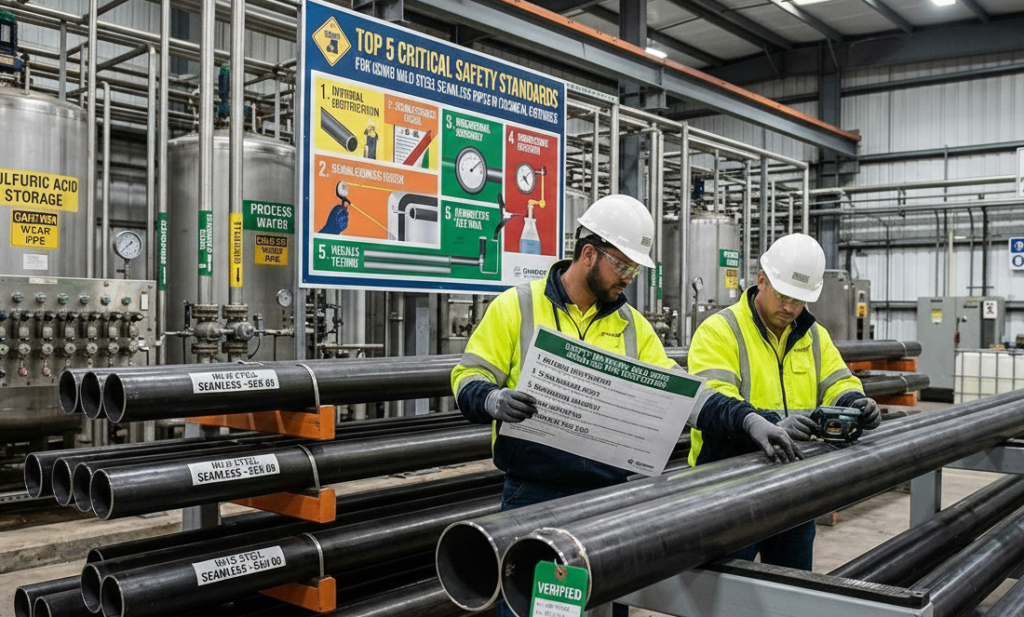
In the high-stakes environment of a chemical processing plant, the infrastructure holding everything together is just as important as the chemicals themselves. Seamless pipes are the workhorses of these facilities. Unlike welded pipes, which have a longitudinal seam that can act as a point of failure under stress, a mild steel pipe is manufactured through an extrusion process, resulting in a continuous, solid wall.
However, even the strongest ms pipes can fail if safety standards aren’t strictly followed. In a chemical factory, a pipe failure doesn’t just mean a leak; it can mean toxic exposure, fires, or catastrophic explosions. To ensure the longevity of your infrastructure and the safety of your personnel, adhering to international and industrial safety standards is non-negotiable.
1. Pressure Rating and Wall Thickness Compliance (ASME B31.3)
The most fundamental safety standard for any ms pipes used in chemical processing is compliance with pressure piping codes, specifically ASME B31.3. This standard dictates how pipes must be designed to handle the internal pressure of the fluids they carry. In a chemical factory, fluids are often moved at high velocities and varying pressures. If a mild steel seamless pipe has a wall thickness that is too thin for the intended pressure, it can undergo “creep” or sudden bursting.
When selecting mild steel pipes, engineers must calculate the “Schedule” of the pipe This number represents the wall thickness relative to the pipe’s diameter. In hazardous chemical environments, safety margins are added to these calculations to account for potential surges in pressure or mechanical vibrations.
- Design Pressure: Always ensure the ms pipe is rated for the maximum possible pressure the system can generate, not just the “normal” operating pressure.
- Hydro static Testing: Before a new line of seamless pipes is commissioned, it must undergo hydro static testing filling the pipe with water at pressures exceeding its rating to check for leaks.
- Safety Factors: Engineers often apply a safety factor of 3:1 or 4:1, meaning the pipe is built to withstand three to four times the pressure it will actually face.
2. Corrosion Management and Material Compatibility
While mild steel pipes are incredibly strong, they are susceptible to corrosion when exposed to certain acids, alkalis, or moisture. In a chemical factory, “corrosion under insulation” (CUI) or internal chemical erosion can thin the walls of a seamlesspipe over time, leading to a “pinhole” leak that can quickly escalate into a major rupture. Safety standards require a thorough analysis of the chemical compatibility between the pipe and the medium it carries.
To mitigate this, many factories use mild steel seamless pipes that have been treated with protective coatings or linings. Furthermore, the standard practice includes adding a “Corrosion Allowance” to the initial wall thickness. This means if a pipe needs to be 5mm thick to hold pressure, it is manufactured at 8mm thick to allow for 3mm of gradual rust or erosion over 20 years without compromising safety.
- External Coatings: Galvanization, epoxy coatings, or specialized polymer wraps protect the ms seamless pipes from the humid or acidic atmosphere of the factory floor.
- Internal Linings: For highly reactive chemicals, the interior of the seamless pipe might be lined with PTFE (Teflon) or glass to prevent the chemical from touching the steel directly.
- Sacrificial Anodes: In some setups, “cathodic protection” is used, where a more reactive metal is attached to the piping system to corrode in place of the ms seamless pipes.
3. Rigorous Non-Destructive Testing (NDT) Standards
Because a mild steel seamless pipe is produced through intense heat and mechanical stretching, internal defects like “laps,” “seams,” or “slivers” can occasionally occur during manufacturing. While these might be invisible to the naked eye, they become catastrophic failure points under high pressure. Safety standards like ASTM A106 or API 5L require that these pipes undergo Non-Destructive Testing (NDT) to ensure structural integrity before they ever reach a chemical plant.
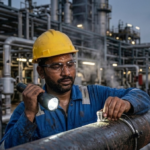
In a chemical factory setting, NDT doesn’t stop after installation. Regular “In-Service Inspections” are mandatory. Using ultrasonic waves or X-rays, technicians can measure the remaining wall thickness of an ms pipe while it is still in use. This allows the facility to replace aging pipes before they reach a dangerous level of degradation.
- Ultrasonic Testing (UT): Uses high-frequency sound waves to detect internal flaws or measure thickness.
- Radiographic Testing (RT): Uses X-rays to create an image of the pipe’s internal structure, identifying cracks that aren’t visible on the surface.
- Magnetic Particle Inspection (MPI): Used specifically on mild steel seamless pipes to find surface-breaking cracks by using magnetic fields and iron powder.
4. Precision in Flange and Joint Connections
A piping system is only as strong as its weakest link, which is almost always the joint. When connecting sections of seamless pipes, the methods used whether welding, threading, or flanging must meet strict safety codes (such as ASME B16.5). In chemical factories, leaks at the joints are the leading cause of “incidental exposure,” where workers are harmed by dripping chemicals.
For ms pipes, “Butt-Welding” is the preferred method for permanent connections because it maintains the “seamless” nature of the flow. However, where pipes need to be disconnected for cleaning or maintenance, flanged joints are used. These joints must be perfectly aligned; if a flange is bolted on crookedly, it creates “residual stress” in the mild steel seamless pipe, which can lead to stress-corrosion cracking over time.
- Gasket Selection: The material between the two pipe ends must be chemically resistant to the fluid. Using the wrong gasket can lead to a blowout.
- Torque Control: Bolts on ms pipe flanges must be tightened using calibrated torque wrenches to ensure even pressure across the seal.
- Welder Certification: Any welding done on mild steel pipes in a chemical plant must be performed by certified high-pressure welders (e.g., ASME Section IX) to ensure the weld is as strong as the pipe itself.
5. Thermal Expansion and Support Engineering
Chemical reactions often involve extreme temperature changes. As a mild steel pipe heats up, the metal physically expands. If the pipe is “fixed” too tightly between two walls or machines, that expansion has nowhere to go. The resulting internal force can buckle the pipe or tear it away from its supports. Safety standards require that piping systems be designed with “flexibility” to handle these thermal cycles.
Properly engineered supports and “expansion loops” are vital for seamless pipes. These loops allow the pipe to bend slightly and absorb the growth caused by heat without putting stress on the pumps or valves. Additionally, the spacing of supports must be calculated to prevent the mild steel pipe from “sagging” under its own weight when full of heavy chemical liquid.
- Expansion Loops: U-shaped sections of mild steel seamless pipes that act like a spring to absorb thermal movement.
- Variable Spring Hangers: Pipe supports that use internal springs to allow the pipe to move up or down as it expands and contracts.
- Vibration Dampening: In systems where pumps create a lot of “chatter,” dampeners are installed to prevent the seamless pipes from vibrating to the point of fatigue failure.
Why “Seamless” Matters in Chemical Safety
You might wonder why we specify ms seamless pipes instead of the cheaper welded alternatives. The answer lies in the “Joint Efficiency.” A welded pipe has a seam that is statistically more likely to fail than the rest of the pipe body. In the world of high-pressure chemicals, having a mild steel seamless pipe means there is no “weakest line.” The pipe is equally strong at every degree of its circumference. This uniformity makes it much easier to predict how the pipe will behave under stress, making your safety calculations more accurate and your factory much safer for everyone involved.
Safety in chemical piping is non-negotiable. Whether you are upgrading an existing facility or starting a new project in Tamil Nadu, choosing the right pipes and following strict standards is essential. Does your chemical factory meet current safety standards? Contact team at Black Build tech today for a consultation on high-quality MS Seamless Pipes and safety compliance for your piping infrastructure.
Frequently Asked Questions
Why are seamless pipes safer than welded pipes for chemical factories?
Seamless pipes have no weld seam, which is usually the weakest point in a pipe. This makes them much less likely to leak or burst under high pressure or corrosive conditions.
What is the best MS Seamless Pipe grade for acidic chemicals?
While MS pipes are strong, they are not naturally acid-resistant. For acidic chemicals, you must use a seamless pipe with a specialized internal lining like PTFE or choose stainless steel grades.
What does “Schedule 40” or “Schedule 80” mean in terms of safety?
The schedule number refers to the thickness of the pipe wall. A higher schedule (like 80) means a thicker wall, which can safely handle higher pressures common in chemical processing.
How often should MS Seamless Pipes be inspected in a chemical plant?
Safety standards typically recommend a visual inspection every 6 months and a full thickness and NDT check every 2 to 5 years, depending on the corrosiveness of the chemicals.
Is ASTM A106 the only standard for chemical piping?
It is the most common for high temperature, but ASTM A53 is also used for lower pressure applications. Always check your project engineering specifications.
Can MS Seamless Pipe be used for flammable chemical transport?
Yes, but the system must be properly grounded to prevent static electricity buildup, and the pipe must be rated for the specific flashpoint and pressure of the chemical.
What is a Mill Test Certificate (MTC) and why is it a safety requirement?
An MTC is a document that proves the pipe was manufactured to specific chemical and mechanical standards. It is the only way to verify that the pipe is safe for industrial use.
Do I need to paint MS Seamless Pipes in a chemical factory?
Yes. In industrial areas, especially near the coast in Tamil Nadu, external painting is a safety standard to prevent rust from weakening the pipe from the outside.
What is Hydrostatic testing for MS pipes?
It involves filling the pipe with liquid at high pressure to ensure there are no leaks. It is a mandatory safety test before a chemical line goes “live.”
Where can I buy certified MS Seamless Pipe in Tiruppur or Chennai?
You should only buy from established suppliers who provide full traceability, Heat Numbers, and Mill Test Certificates for every order.
Related posts:
 Essential Maintenance Tips for Mild Steel Seamless Pipes in Chemical Factories Preventing Acidic Corrosion
 IBR Certified MS Seamless Pipes Understanding Safety Standards for Tamil Nadu Power Plants
 The Role of MS Seamless Pipes in Oil Refineries Safety Standards Every Worker Should Know
 Top 5 Common Troubles with MS Seamless Pipes and How to Fix Them On-Site