
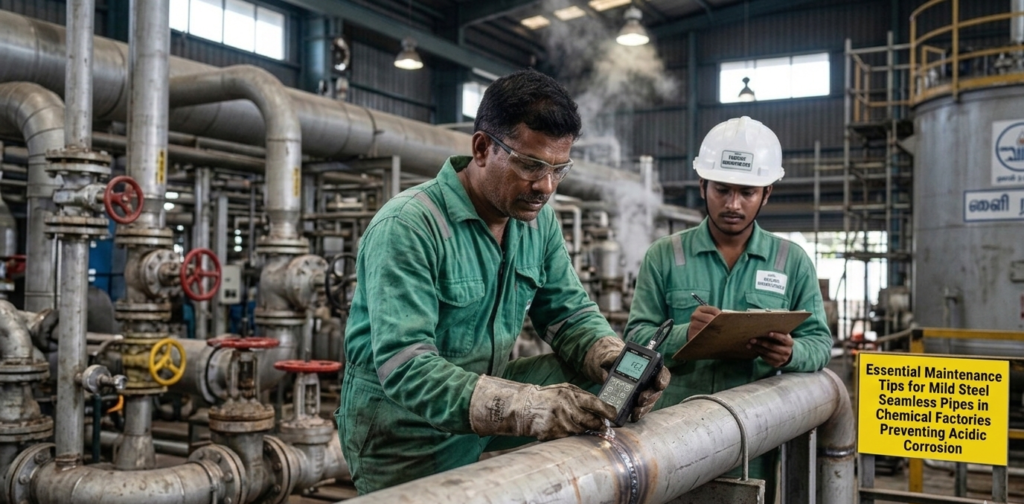
Chemical factories are some of the most punishing environments for industrial infrastructure. In these facilities, seamless pipes are often chosen for their strength and cost-effectiveness. However, their biggest enemy is acidic corrosion. Without a rigorous maintenance strategy, a high-pressure line can fail in a matter of months, leading to hazardous leaks and expensive downtime. This guide provides a comprehensive roadmap for maintaining your Mild Steel seamless pipes network to ensure it survives the harsh chemical processing landscape.
Regular monitoring is also a non-negotiable part of the maintenance process. In a high-pressure chemical line, a small leak is never just a small leak; it is a warning sign of a systemic failure. By using ultrasonic thickness gauges, technicians can measure the internal wear of the mild steel pipe without needing to shut down the entire plant. This allows your team to identify “thin spots” caused by internal erosion or chemical reactions before they turn into a catastrophic burst.
Finally, proper support and insulation management play a huge role in pipe longevity. In many chemical factories, moisture gets trapped between the pipe surface and its insulation a silent killer known as Corrosion Under Insulation (CUI). By ensuring that your MS seamless pipes are properly sealed and that the pipe stands are designed to prevent “metal-on-metal” rubbing, you can eliminate the hidden friction and moisture traps that cause premature failure. Taking these proactive steps ensures your infrastructure remains a reliable asset rather than a constant safety risk.
How Acid Corrodes MS Pipes
- Mild steel is primarily composed of iron and carbon. When exposed to acids (like sulfuric, hydrochloric, or phosphoric acid), a chemical reaction occurs that strips away the iron atoms. Because Mild steel seamless pipes lack a longitudinal weld, they do not have a “weak seam” for acid to exploit. However, the entire surface remains vulnerable to “general thinning” or “pitting corrosion.”
- This chemical vulnerability means that while the structural integrity of mild steel seamless pipes is superior to welded alternatives, the rate of metal loss can be deceptively uniform across the entire inner diameter.
- In a process known as “general thinning,” the acid continuously reacts with the iron to form soluble salts, which are then swept away by the fluid flow, steadily reducing the pipe’s wall thickness. Conversely, “pitting corrosion” is a more insidious threat; it occurs when the chemical attack concentrates on small, localized areas, drilling deep holes into the pipe wall while the surrounding surface appears relatively untouched.
- The absence of a weld seam in ms seamless pipes is a major advantage here because it eliminates the “heat-affected zone” where grain boundaries are often more susceptible to rapid intergranular corrosion. In welded pipes, acid often “zips” open the seam long before the rest of the Mild Steel seamless pipe fails.
- With mild steel seamless pipe, the failure mode is typically more predictable, but it requires constant vigilance. If the iron-to-acid reaction is not managed through the protective strategies mentioned above, the pipe will eventually reach a “critical thinness” where it can no longer contain the internal pressure, leading to a sudden and dangerous rupture.
1. The Power of External Protective Coatings
- In a chemical factory, the air itself is often corrosive. Fumes and humidity can settle on the exterior of your MS Seamless Pipes, leading to “Corrosion Under Insulation” (CUI) or direct atmospheric rusting.
- The external degradation of mild steel seamless pipes is particularly dangerous because it often happens out of sight. When these pipes are wrapped in thermal insulation, any moisture or corrosive chemical vapor that seeps through the outer cladding becomes trapped against the steel surface.
- This creates a “wicking” effect where the insulation stays damp, leading to Corrosion Under Insulation (CUI). Because the insulation hides the pipe, the metal can turn to flaky rust while the exterior of the pipe cladding looks perfectly normal. In a high-pressure chemical environment, this hidden thinning reduces the structural integrity of the MS seamless pipe, making it prone to sudden blowouts rather than slow, detectable leaks.
- Tip: Use a multi-layer coating system. Start with a zinc-rich epoxy primer, which acts as a sacrificial layer. Follow this with a high-build intermediate coat and a UV-resistant polyurethane topcoat. This “armor” prevents the acidic environment from ever touching the steel surface.
2. Creating a Barrier
For pipes carrying concentrated acids, the steel alone is often not enough. Mild steel seamless pipes serve as the “strength member,” while an internal lining provides the “chemical resistance.”
- PTFE and PFA (Fluoropolymers): These are the most chemically inert linings available for mild steel seamless pipes. They can handle nearly all concentrated acids, including sulfuric and nitric, at temperatures up to 200°C. Because they are non-stick, they also prevent “scaling” or chemical buildup that can restrict flow over time.
- Rubber and Elastomeric Linings: For abrasive chemical slurries or phosphoric acid, thick rubber linings are often preferred. The rubber acts as a shock absorber for the MS seamless pipe, protecting the metal from both chemical erosion and the physical “scouring” caused by fast-moving particles.
- Glass and Ceramic Linings: In specialized high-purity processes where even a trace amount of metal contamination is forbidden, glass-lined mild steel seamless pipes are used. This creates a completely smooth, non-porous surface that is impervious to most acids, though it requires careful handling to avoid mechanical “shock” or cracking.
- Tip: Consider PTFE (Teflon) or Rubber linings for highly aggressive acids. For milder solutions, baked-on epoxy linings can be highly effective. These linings prevent the acid from coming into direct contact with the carbon steel, effectively eliminating the chemical reaction that causes thinning.
3. Rigorous Ultrasonic Thickness (UT) Testing
This internal degradation is often a silent killer in high-pressure systems because the uniform appearance of the exterior hides the structural decay occurring within. To accurately track the health of your mild steel seamless pipes, you must move beyond visual checks and employ specialized measurement techniques:
- Establish a “Corrosion Mapping” Schedule: Use Ultrasonic Thickness (UT) meters to measure the wall thickness at specific high-stress points such as elbows, tees, and low-lying sections every six months. Since MS seamless pipe lacks a weld seam, the thinning may be more even, but turbulence at bends can still cause localized “scouring.”
- Monitor Against the “Original Schedule”: Always compare your current readings to the pipe’s original nominal thickness (e.g., SCH 40 or SCH 80). If a mild steel seamless pipe section loses more than 25% of its specified wall thickness, it should be flagged for immediate replacement during the next scheduled plant shutdown to prevent a catastrophic burst.
- Track the “Corrosion Rate” Over Time: By recording measurements in a digital log, you can calculate the “mils per year” (MPY) of metal loss. This data allows you to predict the remaining service life of your ms seamless pipes and order replacement materials well in advance, avoiding expensive emergency procurement.
- Tip: Establish a “Corrosion Mapping” schedule. Use UT meters to measure the wall thickness at specific points (elbows, tees, and low points) every six months. If a pipe section loses more than 25% of its original “schedule” thickness, it should be flagged for immediate replacement during the next shutdown.
4. Managing Flow Velocity and Stagnation
This interaction between fluid dynamics and chemical reactivity means that the longevity of mild steel seamless pipes is often dictated by the “flow profile” of the system. To prevent premature failure in high-pressure or high-acidity lines, you must manage these two extremes of fluid movement:
- Prevent “Scouring” at High Velocities: When acidic fluids move too quickly, they physically “scrub” the microscopic protective oxide film off the inner surface of the MS seamless pipe. This exposes fresh, reactive iron to the acid, leading to a rapid cycle of corrosion and erosion that thins the pipe wall much faster than standard chemical exposure would.
- Eliminate “Dead Legs” and Stagnation: These are sections of the mild steel seamless pipe network where the fluid does not move. Stagnant acid allows solids to settle at the bottom of the pipe, creating “under-deposit” corrosion cells where the acid concentrates and eats deep pits into the steel, often leading to a localized breach while the rest of the pipe remains thick.
- Implement Regular System Flushing: To maintain the integrity of ms seamless pipes in systems with intermittent flow, you must establish a schedule to flush the lines with water or a neutralizing agent. This removes stagnant chemical pockets and prevents the “nesting” of corrosive agents that occurs during plant downtime or low-production cycles.
- Tip: Design your system to eliminate dead legs. If they must exist, ensure they are flushed regularly with water or a neutralizing agent to prevent acid from sitting and eating through the pipe wall.
5. Inhibitor Dosing and pH Control
Instead of only treating the symptoms of decay, you can chemically modify the environment inside your MS seamless pipes to stop the reaction at the molecular level. This approach focuses on the “process fluid” itself, turning a corrosive stream into a manageable one through the following methods:
- Establish a “Chemical Shield” with Inhibitors: Corrosion inhibitors are specialized additives that migrate to the inner wall of the mild steel seamless pipe. They work by forming a microscopic, one-molecule-thick hydrophobic film that acts as a physical barrier, preventing acidic ions from reaching and reacting with the iron in the steel.
- Maintain Strict pH Control: Even a minor shift toward a more neutral pH can exponentially reduce the “appetite” of the fluid for carbon steel. By continuously monitoring and adjusting the acidity of the process stream, you can ensure your ms seamless pipe network operates within its safe chemical design limits, potentially doubling its service life without any mechanical changes
- Prevent “Under-Deposit” Attack: Proper chemical dosing also helps prevent the buildup of scales and sediments inside mild steel seamless pipes. In a stagnant or low-flow environment, these deposits can create “localized corrosion cells” where acid becomes trapped against the metal, leading to deep pitting that can bypass even the thickest pipe schedule.
- Tip: Inhibitors work by forming a microscopic film on the inner surface of the MS Seamless pipe. This film acts as a shield against acid. Regularly monitor the pH levels of your process fluids; even a slight shift toward a more neutral pH can double the lifespan of your piping.
Is your chemical facility struggling with frequent pipe replacements? Don’t let acidic corrosion compromise your safety and profits. Our team specializes in supplying high-durability, MS Seamless Pipes and providing technical maintenance consultations tailored for the chemical industry.
Contact our Engineering Experts today for a quote on premium MS Seamless pipe solutions.
Frequently Asked Questions
Why are seamless pipes better than welded pipes for chemical plants?
Seamless pipes have a uniform grain structure. Welded pipes have a seam that is often more susceptible to “preferential weld corrosion” in acidic environments.
How often should I inspect MS Seamless pipes in an acid plant?
For high-concentration areas, visual inspections should be weekly, and thickness testing (UT) should be performed at least every six months.
What is the best coating for MS Seamless pipe in a corrosive environment?
A three-coat system consisting of a zinc-rich epoxy primer, an epoxy mid-coat, and a polyurethane top-coat is the industry standard for chemical plants.
Can mild steel handle sulfuric acid?
Yes, but only in very high concentrations (above 90%) where it forms a protective “sulfate film.” In dilute concentrations, it will eat through Mild steel seamless pipes very quickly.
What are the signs of internal pipe corrosion?
Look for a decrease in flow pressure, discolored fluid (reddish/brown), or “pimple-like” bumps on the exterior of the pipe.
What is “Pitting Corrosion”?
Pitting is localized corrosion that creates small, deep holes. It is dangerous because it can cause a pipe to fail even if the rest of the pipe looks thick and healthy.
How does temperature affect MS Seamless pipe corrosion?
Higher temperatures generally speed up chemical reactions. For every 10-degree Celsius increase, the rate of acidic corrosion can nearly double.
Is it safe to patch a leaking acid pipe?
Only as a temporary emergency measure. For long-term safety, the damaged section of the MS Seamless pipe must be cut out and replaced.
What is the role of a “sacrificial anode” in piping?
In some cases, a more reactive metal (like zinc) is attached to the pipe. The acid attacks the zinc instead of the steel, protecting the pipe.
How do I choose the right “Schedule” for my pipe?
The “Schedule” refers to wall thickness. In chemical plants, engineers often choose a higher schedule (like Schedule 80 instead of 40) to provide an extra “corrosion allowance.”
Related posts:
 ASTM A106 vs ASTM A53 for High Pressure Boilers and Mild Steel Seamless Pipes
 Why Mild Steel Seamless Pipes are the Gold Standard for High-Temperature Steam Lines in TN Industries
 How to Select Wall Thickness (SCH 40/80) for Mild Steel Seamless Pipes in Coimbatore
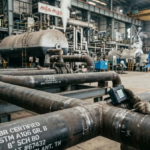 IBR Certified MS Seamless Pipes Understanding Safety Standards for Tamil Nadu Power Plants