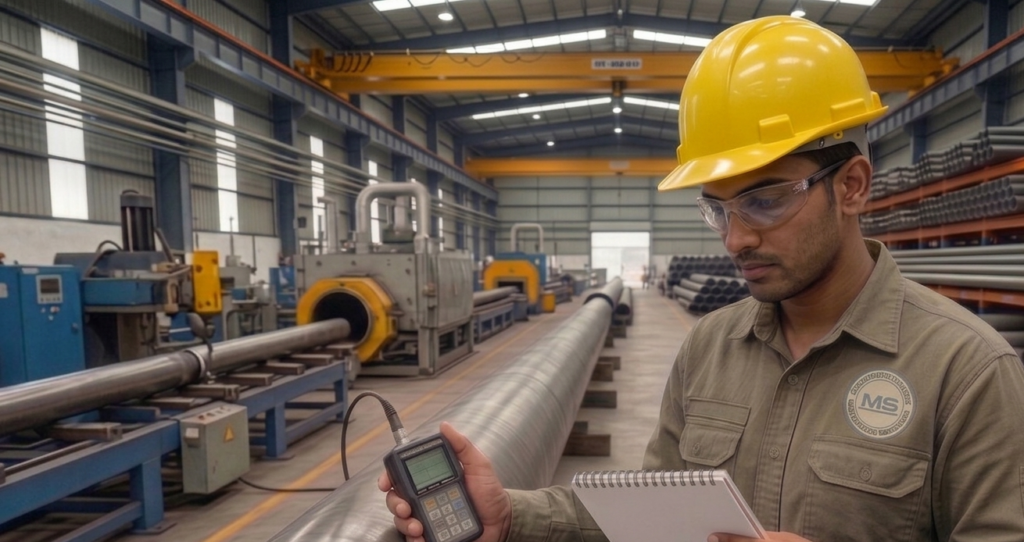
For a junior procurement engineer, the responsibility of sourcing seamless pipes can be daunting. In industries like power generation, oil and gas, and chemical processing, the integrity of a piping system is non-negotiable. Using a sub-standard or counterfeit pipe can lead to catastrophic failures, legal liabilities, and massive financial losses. The market is unfortunately flooded with “fakes” , often ERW (Electric Resistance Welded) pipes that have been polished or “bead-removed” to look like seamless ones. This guide provides a professional checklist to ensure the Seamless pipes you procure are 100% genuine and fit for purpose.
To identify these deceptive “bead-removed” pipes, your first line of defense is a detailed Internal Visual Inspection. While the exterior of a counterfeit pipe may be polished to perfection, the interior often tells a different story. Use a high-intensity flashlight or a borescope to examine the internal wall; genuine MS seamless pipes will have a consistent, slightly rough “orange peel” texture or a smooth, uniform finish throughout. In contrast, a fake seamless pipe which is actually a welded ERW pipe will often show a faint, straight longitudinal line where the internal weld bead was mechanically scraped away. Even with advanced polishing, this “shadow line” or a slight change in the grain reflection usually remains visible to a trained eye.
Beyond visual cues, the most definitive proof of authenticity lies in the Mill Test Certificate (MTC) and Heat Number Traceability. Every genuine seamless pipe is stamped or stenciled with a unique “Heat Number” that must correspond exactly to the MTC provided by the manufacturer. Ensure the MTC is a “Type 3.1” certificate according to EN 10204 standards, which guarantees that the specific batch was tested and verified by the mill’s independent Q.A. department. As a procurement engineer, you should cross-verify the chemical composition (specifically carbon and manganese levels) and mechanical properties like tensile strength and elongation against the required ASTM or API standards. If a supplier cannot provide a clear, traceable link between the physical pipe and its certification, the material should be rejected immediately to avoid the risk of catastrophic structural failure.
The Core Difference: Why Seamless Matters
Before diving into the checklist, it is vital to understand what makes a Mild steel seamless pipe unique. Unlike welded pipes, which are formed from a flat plate and joined at a seam, seamless pipes are created by piercing a solid steel billet. This process results in a pipe that has no joints and a uniform metallurgical structure. This uniformity allows it to handle significantly higher pressures and temperatures, making it the “Gold Standard” for critical industrial lines.
Step 1: The Visual Inspection Checklist
Your first line of defense is a thorough physical inspection. Genuine MS Seamless pipes have distinct characteristics that are hard to replicate.
- Check the Internal Surface: Shine a high-intensity torch inside the pipe. A genuine seamless pipe will have a relatively smooth internal bore. If you see a faint, straight line running down the length of the pipe, it is likely a welded pipe where the internal bead was removed.
- Examine the Mill Scale: New pipes usually have “mill scale” a bluish-black flaky surface. On seamless pipes, this scale should be uniform. Patchy or artificially painted surfaces might be hiding weld lines or surface defects.
- Inspect the Pipe Ends: Look at the thickness of the pipe at the ends. Genuine seamless pipes will show a consistent wall thickness. If the “bevel” (the angled edge for welding) looks uneven or hand-ground rather than machine-cut, it is a red flag.
Step 2: Mastering the Mill Test Report (MTR)
As a procurement engineer, the paperwork is as important as the metal. Every batch of Mild steel seamless pipes must come with an MTR.
- Traceability (The Heat Number): Every pipe should have a “Heat Number” stamped on it that matches the MTR exactly. If the numbers do not match, the pipe has no legal traceability and should be rejected.
- Chemical Analysis: Check the carbon content. For standard grades like ASTM A106 Grade B, the carbon should generally not exceed 0.30%. High carbon makes the pipe brittle and difficult to weld.
- Mechanical Testing: The MTR must list the Tensile Strength, Yield Strength, and Elongation. Compare these values against the ASTM or IBR standards to ensure they fall within the “Passed” range.
Step 3: Physical Marking and Stamping
Standards like ASTM A106 or API 5L dictate how pipes must be marked.
- Hard Stamping vs. Paint Stenciling: While most pipes have paint stenciling for easy reading, high-quality seamless pipes often feature “hard stamping” near the end. This includes the manufacturer’s logo, the size, the schedule (thickness), and the IBR stamp (if applicable).
- The “S” Mark: Under many international standards, seamless pipes are explicitly marked with an “S” to denote their manufacturing process.
- Heat Number and Traceability Stamping: Every genuine MS seamless pipe must be indelibly marked with a unique Heat Number. This alphanumeric code acts as the pipe’s “DNA,” linking the physical product directly to its Mill Test Certificate (MTC). During your inspection, ensure this number is either hard-stamped or clearly stenciled and matches the documentation exactly. If the heat number is missing, illegible, or does not align with the provided certificates, the pipe should be quarantined immediately, as it cannot be legally or technically verified for high-pressure service.
Step 4: Dimensional Verification
Don’t just trust the markings; verify them with tools.
- Ultrasonic Thickness (UT) Gauging: Use a portable UT meter to check the wall thickness at four different points around the circumference. Seamless pipes have a “permissible variation” (usually around 12.5%), but if you find a specific “thin line” along the length, it suggests a welded joint is being hidden.
- The Weight Test: Calculate the theoretical weight of the pipe based on its dimensions and compare it to the actual weight. Significant discrepancies often point to “under-tolerance” pipes that may fail under pressure.
- Ovality and End-Squareness Check: Use a large-scale vernier caliper to measure the outside diameter (OD) at the pipe ends to ensure the pipe is perfectly circular. A genuine seamless pipe must maintain strict circularity; if it is “oval,” achieving a proper root gap during welding becomes nearly impossible. Additionally, use a precision square to confirm the pipe ends are cut at a perfect $90^{\circ}$ angle, as slanted ends often indicate salvaged or poorly processed material.
Red Flags for Procurement Engineers
When sourcing MS seamless pipes, certain warning signs indicate that the material may be counterfeit or substandard. If you notice these red flags, stop the transaction immediately to protect your project’s safety and budget:
- Prices That Seem Unrealistic: Genuine seamless pipes require a much more expensive and complex manufacturing process than welded pipes. Because of this, they typically cost 20% to 30% more to produce. If a supplier offers you “seamless” pipes at the same price as welded ones, they are likely selling you a cheaper product disguised as a premium one.
- Suspicious or Poor Stenciling: High-quality mills use professional, automated systems for marking. If the paint stenciling looks like it was applied by hand, contains spelling errors in the brand name, or looks “too new” on a pipe that appears rusted or old, it is a sign of a “re-rolled” product from a local mill rather than a genuine factory-made pipe.
- The “Delayed” MTR (Mill Test Report): A Mill Test Report is the legal “birth certificate” of the pipe, proving its strength and chemical makeup. You should never accept a shipment where the supplier promises the MTR is “on the way” or “coming later.” Without the certificate physically present at the time of delivery, you have no proof of what you are actually buying.
- Visible Internal Weld Lines: Even if the outside looks smooth, look inside the pipe with a flashlight. Genuine seamless pipes have a uniform internal surface. If you see a straight, faint line running down the inside or a rough area where a “bead” was clearly ground down the pipe is actually a welded (ERW) pipe being sold as a fake seamless one.
The Environmental Factor: Storage and Handling
Even a genuine Mild steel seamless pipe can be ruined by poor handling. In humid regions like Coimbatore or Chennai, pipes stored on bare soil will undergo “pitting corrosion.” Ensure the pipes you procure were stored on wooden dunnage and have protective end-caps. This ensures the internal bore remains clean and free of debris before it reaches your project site.
Are you looking to secure high-quality, 100% verified MS Seamless pipes for your next project? Procurement doesn’t have to be a gamble. Partner with a supplier that provides full traceability and IBR certification.
Contact our Black Buildtech team today for a free consultation on material verification and a quote for your industrial piping needs.
Frequently Asked Questions
How can I tell the difference between seamless and ERW pipes?
Seamless pipes have no longitudinal weld seam. You can check this by looking at the internal bore or using ultrasonic testing to find variations in wall thickness that would indicate a weld joint.
Is MS Seamless pipe the same as carbon steel pipe?
“Mild Steel” is a type of carbon steel with low carbon content. While most Mild steel seamless pipes are carbon steel, not all carbon steel pipes are seamless. “Seamless” refers to the manufacturing method.
What is the most common grade for MS Seamless pipes?
ASTM A106 Grade B is the most widely used grade for high-temperature and high-pressure applications in industries like power plants and refineries.
Why are seamless pipes more expensive than welded ones?
The manufacturing process heating a solid billet and extruding it requires more energy and specialized machinery compared to the rolling and welding process used for ERW pipes.
What is an IBR Certificate?
An IBR (Indian Boiler Regulations) certificate confirms that the pipe has been manufactured and tested according to the strict safety standards required for steam-bearing systems in India.
Can a seamless pipe have surface defects?
Yes, minor surface “scabs” or mill scales are normal. However, deep cracks, pits, or “slivers” are grounds for rejection as they act as stress concentrators.
What tools do I need for on-site pipe inspection?
A junior engineer should carry a measuring tape, a Vernier caliper (for outer diameter), an Ultrasonic Thickness Gauge, and a high-intensity flashlight.
Does “Seamless” mean the pipe won’t rust?
No. Mild steel will rust if exposed to moisture and oxygen. However, seamless pipes are often preferred because they do not suffer from “weld decay” or preferential corrosion at the seam.
What should I check first on a Mill Test Report?
Check the “Heat Number” first. If the number on the paper doesn’t match the number stamped on the pipe, the entire report is useless for that specific pipe.
Can I use non-IBR pipes for a boiler system?
In India, it is illegal and extremely dangerous to use non-IBR pipes for any system where the steam pressure exceeds the threshold set by the Boiler Act. Always verify local regulations.
Related posts:
 Top 5 Common Troubles with MS Seamless Pipes and How to Fix Them On-Site
 Why Mild Steel Seamless Pipes are the Gold Standard for High-Temperature Steam Lines in TN Industries
 The Role of MS Seamless Pipes in Oil Refineries Safety Standards Every Worker Should Know
 How to Select Wall Thickness (SCH 40/80) for Mild Steel Seamless Pipes in Coimbatore