
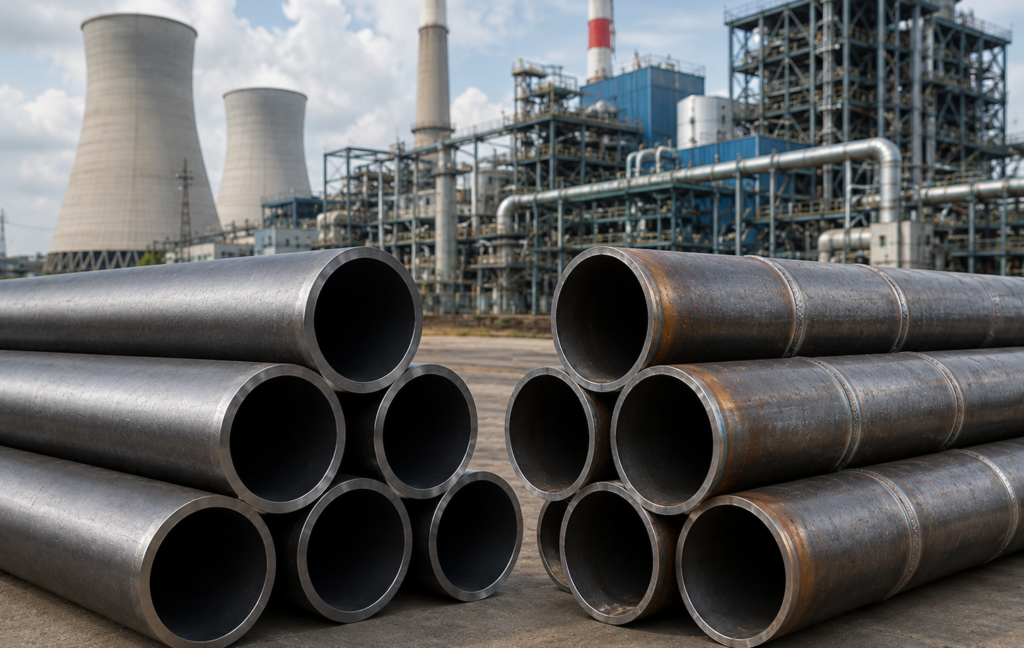
In the demanding world of power plant engineering, the piping infrastructure is responsible for transporting high-pressure steam, cooling water, and fuel. The choice between Seamless pipes and welded pipes is a fundamental engineering decision that affects the plant’s safety, longevity, and operational efficiency.
A Seamless Pipe is often viewed as the premium choice for high-stress environments, while welded pipes offer a versatile solution for large-scale, lower-pressure systems. Understanding the nuanced technical differences between these two is essential for avoiding catastrophic failures and optimizing the life cycle costs of a power generation facility.
The main difference lies in how these pipes are built. In contrast, a Welded Pipe is made by rolling a flat sheet of steel into a circle and joining the edges with a high-heat weld. This “seam” is naturally the most vulnerable part of the pipe, as it is where cracks or corrosion are most likely to start under high pressure.
In a power plant, where safety is the top priority, engineers often choose seamless pipes for “critical paths” like high-pressure steam lines. Even though modern welding technology is very advanced, the physical strength of a solid, one-piece tube provides a much higher Factor of Safety. By eliminating the seam, you eliminate the risk of a “split failure,” ensuring the plant stays online and the workers remain safe even during extreme temperature spikes.
Differences Between MS Seamless Pipes and Welded Pipes
1. Manufacturing Methodology and Structural Integrity
The most basic difference lies in how the metal is formed. A ms seamless pipe is produced by heating a solid round steel billet and piercing it with a mandrel to create a hollow tube. This results in a continuous grain structure without any longitudinal or spiral joints.
In contrast, welded pipes are made from flat steel plates or coils that are rolled into a cylindrical shape and joined at the seam using heat and pressure (such as Electric Resistance Welding). In power plant engineering, the absence of a weld in Mild Steel Pipes means there is no “heat-affected zone” (HAZ), which is often the first place a pipe fails under extreme stress.
2. Pressure Carrying Capacity
In a power plant, pipes must withstand immense internal pressure. The “Hoop Stress” in a pipe is distributed evenly across the circumference of seamless pipes. Because there is no seam, there is no inherent weak point.
Welded pipes are subject to “Joint Efficiency” factors. Engineers generally calculate that a welded pipe is only 80% to 85% as strong as a seamless pipe of the same grade and thickness. For high-pressure steam headers or boiler feed lines, the 100% efficiency of a ms pipe is usually a mandatory safety requirement.
3. Performance Under Thermal Cycling
Power plants undergo constant heating and cooling cycles. This causes the metal to expand and contract. Because seamless pipes have a uniform metallurgical structure, they expand and contract evenly.In welded pipes, the weld material and the parent metal may have slightly different thermal expansion coefficients. Over thousands of cycles, this leads to “thermal fatigue” at the seam. For superheaters and reheaters in a power plant, where temperatures can exceed 500°C, the reliability of a Mild Steel Seamless Pipe is unmatched.
4. Corrosion Resistance and Flow Dynamics
Internal corrosion is a major concern in power plant maintenance. Welded pipes can suffer from “seam-preferential corrosion.” The chemical composition of the weld may react differently to treated boiler water, leading to deep pitting along the joint.
Furthermore, seamless pipes provide a smoother internal surface. Welded pipes often have an internal “flash” or bead from the welding process. Even if removed, the surface is never as perfectly smooth as a seamless bore. This smoothness reduces turbulence and friction loss, which improves the overall thermal efficiency of the plant.
5. Dimensional Tolerances and Wall Thickness
Welded pipes are made from flat-rolled steel, which has a very consistent thickness. This means welded pipes often have better dimensional accuracy regarding wall thickness.
Mild Steel Seamless Pipes, due to the piercing and rolling process, can have slight variations in wall thickness (known as eccentricity). However, in power plant engineering, the safety margin provided by the lack of a seam far outweighs the need for perfect wall symmetry.
6. Reliability in Extreme Environments
Power plants are “high-consequence” environments. A pipe failure can lead to an explosion or a total blackout. Seamless Pipes are preferred for any “critical path” application because they eliminate the risk of a “split seam” failure. While modern Non-Destructive Testing (NDT) makes welded pipes very safe, the inherent physics of a seamless tube provides a higher “Factor of Safety.”
In these high-pressure settings, the lack of a longitudinal weld reduces the number of potential stress corrosion sites, which is vital for long-term structural health. By choosing MS seamless pipes, engineers ensure that the system can withstand extreme thermal cycling and pressure spikes without the unpredictable risk of a seam fatigue failure.
7. Handling the Heat and the Pressure
In a power plant, it’s not just about moving liquid; it’s about moving extreme energy. Steam flowing through these pipes can reach temperatures that would melt or weaken ordinary materials.
Because mild steel seamless pipes are one solid piece of metal, they expand and contract uniformly. In welded pipes, the seam can sometimes act as a “stress point” where heat concentrates differently than the rest of the pipe. By using seamless, engineers ensure the pipe stays structurally sound even when the plant is running at full throttle.
8. Cost vs. Longevity
At first glance, seamless pipes often carry a higher price tag than welded ones. However, in the world of power generation, smart managers look at the Life Cycle Cost rather than just the initial receipt.
Because there is no weld seam to monitor for corrosion or cracks, the need for expensive, manual inspections is significantly reduced. More importantly, every hour a power plant is offline for emergency repairs, it loses a fortune in revenue. Seamless pipes act as an insurance policy you pay a bit more upfront to avoid the massive costs of unexpected shutdowns and frequent replacements down the road.
9. Versatility Across the Plant
While they are famous for handling the “heavy lifting” in boilers, mild steel seamless pipes are the versatile workhorses found in almost every corner of a facility. They aren’t just for steam; they manage a variety of vital fluids and gases that keep the plant breathing.
You will find them in fuel lines transporting natural gas to burners, in cooling systems moving massive amounts of water, and in lubrication systems that keep giant turbines spinning smoothly. Their ability to be bent and machined without the risk of a seam splitting makes them the go-to choice for complex layouts where the piping has to twist and turn through tight spaces.
The difference between Seamless pipes and welded pipes is a balance of physics, safety, and budget. For power plant engineering, Mild Steel Pipes remain the gold standard for high-pressure and high-temperature zones where failure is not an option. They offer superior pressure resistance, better thermal fatigue life, and more predictable corrosion patterns.
Welded pipes, while more economical and available in larger diameters, are best reserved for secondary systems where pressures are manageable. By selecting the right pipe for the right application, engineers can ensure the safe and continuous operation of the power facility.
Looking for Certified Piping Solutions?
Don’t compromise on the safety of your power plant project. We provide high-quality Mild Steel Seamless Pipes that meet the strictest ASTM and ASME standards.
Contact our Black Buildtech team today for a quote or a technical consultation on your piping requirements.
Frequently Asked Questions
Why is a MS seamless pipe used for high-pressure steam?
The absence of a weld seam prevents the risk of the pipe splitting open under the extreme pressures typical of steam transport.
Can I use a welded pipe for boiler tubes?
Generally, no. High-pressure boilers require Mild Steel Seamless Pipes because they can handle the intense heat and pressure without the risk of seam failure.
Is there a difference in the cost of MS Seamless pipes and welded pipes?
Yes. Seamless pipes are more expensive to produce due to the complex heating and piercing process.
What are the common sizes for Mild Steel Seamless Pipes?
They are typically available from 1/8 inch to 24 inches. Larger sizes are usually only available as welded pipes.
How do engineers decide between seamless and welded?
The decision is based on the operating pressure, temperature, and the “consequence of failure” as defined by engineering codes like ASME B31.1.
Does a MS seamless pipe rust more than a welded pipe?
No. Both are made of mild steel. Corrosion resistance depends on the protective coatings and the chemistry of the fluid inside the pipe.
What does “ERW” mean in welded pipes?
ERW stands for Electric Resistance Welding. It is a common method for making welded pipes by running an electric current through the edges of the steel.
Are Mild Steel Seamless Pipes tested for leaks?
Yes. They undergo hydrostatic testing where water is pumped into the pipe at high pressure to ensure there are no cracks or thin spots.
Can welded pipes handle high temperatures?
They can handle moderate heat, but in the extreme temperatures of a power plant, the weld joint becomes a risk for thermal cracking.
Where can I find the specifications for a MS seamless pipe?
Specifications are found in international standards like ASTM A106 (for high-temperature service) or ASTM A53.
Related posts:
 IBR Certified MS Seamless Pipes Understanding Safety Standards for Tamil Nadu Power Plants
 ASTM A106 vs ASTM A53 for High Pressure Boilers and Mild Steel Seamless Pipes
 How to Select Wall Thickness (SCH 40/80) for Mild Steel Seamless Pipes in Coimbatore
 How to Identify Genuine MS Seamless Pipes A Checklist for Junior Procurement Engineers