
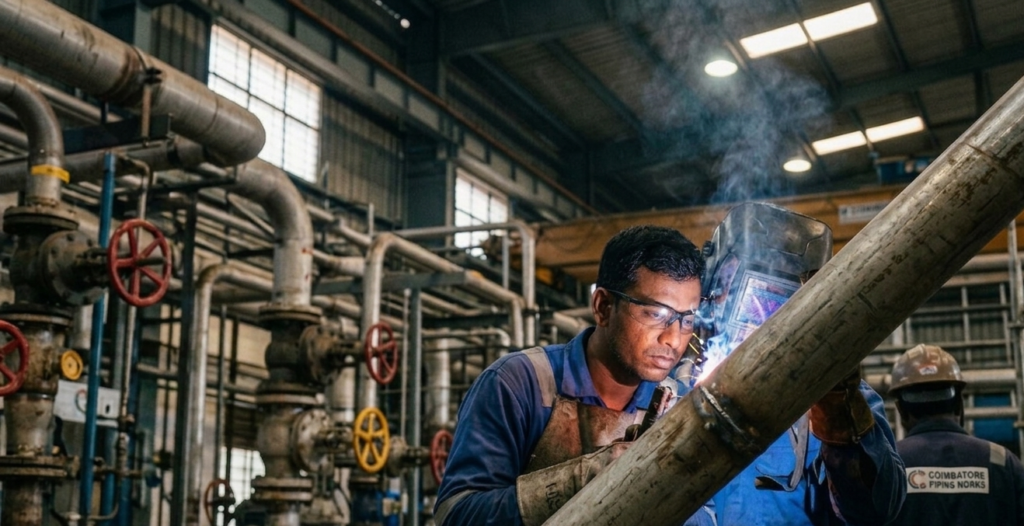
When it comes to high-pressure fluid transport, structural integrity, and industrial durability, Seamless Pipes are the gold standard. Unlike welded pipes, which have a longitudinal seam that can act as a point of failure under stress, mild steel pipes are manufactured through a solid billet piercing process. This results in a uniform, high-strength cylinder capable of handling extreme environments.
Whether you are working on a project in a major industrial hub like Coimbatore or setting up a refinery pipeline, understanding how to handle, install, and weld these pipes is critical for safety and longevity.
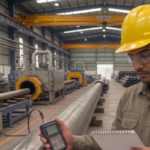
Pre-Installation Inspection and Quality Control
The success of your installation begins before the first weld is even struck. If you are sourcing seamless pipes, you must verify the quality to ensure they meet the project’s engineering specifications.
The Micrometer Test
As discussed previously, use a micrometer to check the wall thickness at the ends. Mild steel seamless pipes should show very little variance in thickness around the circumference. If one side is significantly thinner than the other (eccentricity), it indicates a low-quality manufacturing process.
Weight Verification
Always compare the physical weight of the pipe against the theoretical weight.
- Formula: $W = 0.02466 \times (D – t) \times t$
- If a pipe marked as SCH 80 weighs closer to the theoretical weight of an SCH 40 pipe, you have been sold the wrong grade.
- Ensuring the integrity of MS seamless pipes requires more than just a quick glance at the surface. A robust pre-installation inspection acts as the final gatekeeper against mechanical failure in high-pressure refinery environments.
Physical and Dimensional Verification
Beyond wall thickness and weight, you must ensure the pipe’s geometry hasn’t been compromised during transit or storage.
- Ovality and Roundness Check: Use a large caliper to measure the outside diameter (OD) at multiple points around the circumference. If the pipe is “out-of-round” by more than 1% of the nominal diameter, it will be nearly impossible to achieve a perfect root gap during fit-up, leading to uneven weld stress.
- Straightness (The String Test): Lay the pipe on a flat surface or use a tight string line along its length. A deviation of more than 1.5mm per meter can cause significant alignment issues in long-run piping racks, putting undue strain on support brackets.
Surface Integrity and Visual Inspection
While MS seamless pipes are rugged, they are susceptible to environmental and mechanical damage before they are even installed.
- Pitting and Corrosion: Inspect the internal and external surfaces for deep pitting. While light surface “flash rust” is common and easily cleaned, deep pits can act as “stress concentrators” where cracks can initiate under high-pressure cycles.
- Laminations and Scabs: Look for “slivers” or “scales” of metal that seem to be peeling off the surface. These are manufacturing defects where the steel didn’t bond correctly during the piercing process. In a refinery, these can break off and clog valves or damage downstream turbines.
Documentation and Traceability (The Paper Trail)
In a safety-critical environment, a pipe is only as good as the paperwork that backs it up.
- Heat Number Matching: Every length of seamless pipe should have a Heat Number stenciled on the side. This number must match the Mill Test Certificate (MTC) provided by the supplier.
- MTC Analysis: Don’t just file the MTC, read it. Verify that the Carbon Equivalent ($CE$) is within the weldable range (typically $< 0.45\%$) to ensure you won’t encounter cracking during the welding process.
- Color Coding: Many refineries use a color-coding system (e.g., a green stripe for ASTM A106, a yellow stripe for API 5L). Ensure the stenciling and the color bands align with your facility’s internal safety standards.
Verification Tip: If a pipe lacks a Heat Number or the stencil is illegible, it should be quarantined immediately. In the world of refinery safety, “unidentified” is synonymous with “unsafe.”
Preparation for Installation
Proper preparation prevents 90% of failures in pipe systems. Follow these steps to prepare your ms seamless pipes in coimbatore for the layout:
1. Cutting the Pipe
While mild steel seamless pipes are robust, they must be cut cleanly to ensure a good fit-up.
- Mechanical Sawing: Preferred for thicker walls to prevent heat distortion.
- Abrasive Cutting: Fast, but requires deburring.
- Oxy-Fuel/Plasma Cutting: Common for large diameters, but the edges must be ground back to “bright metal” to remove the slag and hardened layer before welding.
2. End Preparation (Beveling)
For pipes with a wall thickness greater than 3mm, a V-bevel is required for full penetration welds.
- Bevel Angle: Usually $37.5^{\circ}$ ($+/- 2.5^{\circ}$).
- Root Face: Leave a flat section (root land) of about 1.6mm to 2mm to prevent the weld from burning through too quickly.
Step-by-Step Welding Guide for MS Seamless Pipes
To ensure MS seamless pipes maintain their structural integrity in high-pressure refinery environments, the welding process must be executed with surgical precision. Improper welding doesn’t just lead to leaks; it creates localized weak points that can fail under thermal stress.
1. Preparation and Beveling
Before cleaning, the pipe ends must be mechanically prepared to allow for full weld penetration.
- Bevel Angle: For wall thicknesses over 3mm, grind the pipe ends to a 30° to 37.5° bevel. This creates a “V-groove” when two pipes are joined, ensuring the weld isn’t just sitting on the surface.
- The “Root Face”: Leave a flat edge (landing) of about 1.6mm at the bottom of the bevel. This prevents the intense arc from blowing a hole through the metal during the first pass.
2. Deep Cleaning and Contamination Control
Mild steel is “forgiving,” but seamless pipes in refineries often transport volatile materials where porosity is a fatal flaw.
- Mechanical Cleaning: Use a power wire brush or a flap disc to remove the “mill scale” (the dark grey oxide layer from manufacturing) until you see shiny “white metal.”
- Chemical Cleaning: If the pipe was used for oil service, use a non-chlorinated solvent to remove residual hydrocarbons.
- Pre-Heating: If the ambient temperature is below 10°C or the pipe wall is very thick (over 19mm), pre-heat the joint to approximately 50°C to 100°C to drive out moisture and prevent hydrogen cracking.
3. Precision Alignment (The Fit-Up)
In a seamless system, internal misalignment (high-low) causes turbulence and erosion.
- The Gap: Use a “spacer wire” or a dedicated gap tool to ensure a consistent 2.4mm to 3.2mm root gap.
- Tack Welding: Use the same filler metal for tacks as you will for the root pass. In refinery specs, tacks are often “feathered” (ground at both ends to a thin edge) so the main weld bead can consume them smoothly without leaving a lump.
4. The Multi-Pass Welding Strategy
A high-quality seamless pipe joint is never done in one go. It requires a layered approach:
- The Root Pass (The Foundation): Use TIG (GTAW) for the best results. It creates a smooth “buildup” inside the pipe, which is critical for flow efficiency. If using Stick (SMAW), use an E6010 electrode; its deep penetration “digs” into the root gap.
- The Hot Pass: Immediately follow the root pass to burn out any remaining slag and “strangle” the root bead into place.
- The Fill Passes: Using E7018 (Low-Hydrogen) electrodes, fill the V-groove. These electrodes provide high tensile strength and ductility.
- The Cap Pass: This is the final visible layer. It should be slightly convex (1.5mm to 3mm above the pipe surface) to provide reinforcement.
5. Post-Weld Inspection and Cooling
- Controlled Cooling: Never quench a fresh weld with water. Let it cool naturally in still air. Rapid cooling can make the heat-affected zone (HAZ) brittle.
- Visual Check: Inspect for “undercut” (a groove melted into the pipe next to the weld) or “overlap.”
- Slag Removal: Between every single pass, use a chipping hammer and wire brush. Leaving even a tiny speck of slag inside the weld creates a “void” that will fail an X-ray inspection.
Safety Reminder: In a refinery, always ensure a “Hot Work Permit” is active and that the LEL (Lower Explosive Limit) has been tested before striking an arc.
Support and Hanger Installation
A heavy MS seamless pipe filled with liquid exerts massive force on its supports.
- Spacing: Refer to engineering standards (like ASME B31.3) for support spacing. Over-spacing causes the pipe to sag, leading to “pockets” where moisture can collect and cause internal corrosion.
- Thermal Expansion: In steam or hot oil lines, use “sliding supports” or expansion loops. If you fix both ends of a long mild steel pipe run, the heat will cause the pipe to buckle or blow out a flange.
Post-Welding Inspection and Testing
Once the installation of your ms pipe system is complete, you must verify the integrity of the joints.
1. Visual Inspection
Check for:
- Undercut: A groove melted into the pipe wall next to the weld.
- Overlap: Weld metal that has flowed over the surface without fusing.
- Porosity: Tiny holes on the surface.
2. Non-Destructive Testing (NDT)
For critical high-pressure lines:
- Dye Penetrant Testing (DPT): A red dye is applied to find surface cracks.
- Radiography (X-Ray): Used to “see” inside the weld for internal flaws.
- Hydrostatic Testing: The most common final check. The pipe is filled with water and pressurized to 1.5 times its operating pressure to check for leaks.
Common Mistakes to Avoid
- Using ERW Pipe Instead of Seamless: Dealers in competitive markets may try to swap mild steel seamless pipes for cheaper ERW pipes. Always check for the internal seam.
- Incorrect Root Gap: If the gap is too small, you won’t get full penetration, and the joint will be weak. If it’s too large, you’ll get “icicles” (excessive metal) inside the pipe.
- Ignoring the MTC: Buying “un-certified” pipe to save 10% on costs can lead to catastrophic failure if the steel’s carbon content is too high, making it brittle after welding.
- Poor Storage: Even high-quality seamless pipes will degrade if left in the rain without end caps. Internal rust can clog valves and pumps once the system is turned on.
Even though our office is in Coimbatore, we regularly supply high-quality MS Seamless Pipes to Trichy. We handle the transportation from Coimbatore to Trichy, ensuring your project gets the best materials and expert technical support on time.
Contact our Black Buildtech team today for a consultation on IBR-compliant piping solutions and professional welding guidance for your next project.
Frequently Asked Questions
Why are seamless pipes better than welded pipes for chemical plants?
Seamless pipes have a uniform grain structure. Welded pipes have a seam that is often more susceptible to “preferential weld corrosion” in acidic environments.
How often should I inspect MS Seamless pipes in an acid plant?
For high-concentration areas, visual inspections should be weekly, and thickness testing (UT) should be performed at least every six months.
What is the best coating for MS Seamless pipe in a corrosive environment?
A three-coat system consisting of a zinc-rich epoxy primer, an epoxy mid-coat, and a polyurethane top-coat is the industry standard for chemical plants.
Can mild steel handle sulfuric acid?
Yes, but only in very high concentrations (above 90%) where it forms a protective “sulfate film.” In dilute concentrations, it will eat through Mild steel seamless pipes very quickly.
What are the signs of internal pipe corrosion?
Look for a decrease in flow pressure, discolored fluid (reddish/brown), or “pimple-like” bumps on the exterior of the pipe.
What is “Pitting Corrosion”?
Pitting is localized corrosion that creates small, deep holes. It is dangerous because it can cause a pipe to fail even if the rest of the pipe looks thick and healthy.
How does temperature affect MS Seamless pipe corrosion?
Higher temperatures generally speed up chemical reactions. For every 10-degree Celsius increase, the rate of acidic corrosion can nearly double.
Is it safe to patch a leaking acid pipe?
Only as a temporary emergency measure. For long-term safety, the damaged section of the MS Seamless pipe must be cut out and replaced.
What is the role of a “sacrificial anode” in piping?
In some cases, a more reactive metal (like zinc) is attached to the pipe. The acid attacks the zinc instead of the steel, protecting the pipe.
How do I choose the right “Schedule” for my pipe?
The “Schedule” refers to wall thickness. In chemical plants, engineers often choose a higher schedule (like Schedule 80 instead of 40) to provide an extra “corrosion allowance.”
Can I use regular MS pipes for ship building?
While regular mild steel is used, high-pressure lines and structural hull piping usually require Mild steel seamless pipes because they handle the stress of sea-motion and vibration much better than welded pipes.
What electrode is best for welding MS Seamless Pipes?
For the root pass, TIG (ER70S-2) or SMAW (E6010) is best. For filling and capping in heavy fabrication, the E7018 low-hydrogen electrode is the industry standard.
Why is “Seamless” preferred over “Welded” in Trichy’s boiler industry?
Seamless pipes have no joint, making them significantly safer for high-pressure steam. They are also much easier to get certified under IBR (Indian Boiler Regulations).
How do I prevent rust on MS pipes at the site?
Ensure the pipes are stored off the ground, covered with tarps, and that the internal bore is protected by end caps. Applying a light coat of rust-inhibitor oil is also helpful for long-term storage.
Is pre-heating necessary for all MS Seamless Pipe welding?
It depends on the wall thickness. Generally, for pipes thicker than 19mm or for high-carbon grades, pre-heating is necessary to prevent the weld from becoming brittle.
What is the difference between MS Seamless Pipes and Carbon Steel Seamless Pipes?
Technically, Mild Steel is a type of Carbon Steel with low carbon content (0.05% to 0.25%). In most Trichy industries, the terms are used interchangeably for standard pressure piping like ASTM A106.
Can I bend MS Seamless Pipes on-site?
Yes, but it must be done using a proper pipe-bending machine to prevent wall thinning or kinking. For heavy-walled pipes, “hot bending” is often required.
What is a “Root Gap” in pipe welding?
The root gap is the space left between two pipe ends before welding. It allows the weld metal to penetrate through the full thickness of the pipe, ensuring a 100% strong joint.
How do I verify if a pipe is truly seamless?
Check the internal and external surfaces for a longitudinal weld line. Seamless pipes will be smooth all around. Additionally, check the Mill Test Certificate for the “Seamless” manufacturing method.
Why do welds on MS pipes sometimes crack?
Cracking is often caused by hydrogen entrapment, rapid cooling, or using incorrect filler metal. Following proper pre-heating and using dry, low-hydrogen electrodes prevents this issue.
Related posts:
 Best MS Seamless Pipe Dealers in Coimbatore for the Pump and Valve Industry
 Everything You Need to Know About Mild Steel Seamless Pipe Maintenance for Ship Builders
 How to Select Wall Thickness (SCH 40/80) for Mild Steel Seamless Pipes in Coimbatore
 How to Identify Genuine MS Seamless Pipes A Checklist for Junior Procurement Engineers